



DORA Compliance in 2026: What European Businesses Actually Need to Know
If your European business runs on cloud infrastructure — whether you sell SaaS, manage logistics data, or operate connected medical devices — you have probably heard the acronym “DORA compliance” floating around. And you may have thought: That is just for banks, right? Not exactly. Before we explain how it affects Ihrem cloud operations, let us start with a clear, simple explanation of what DORA actually is.
What Is DORA?
DORA (Digital Operational Resilience Act) is a European Union regulation that entered into force on January 17, 2025 . Its official name is *Regulation (EU) 2022/2554*. Think of it as a stress test requirement for the digital age — but instead of testing how much weight a bridge can hold, DORA tests how well your ICT (Information and Communications Technology) systems can handle a cyberattack, a cloud outage, a ransomware event, or even a simple human error.
Before DORA, financial institutions had different rules for operational resilience across each EU country. A bank in Germany might have had strict ICT recovery requirements, while a similar bank in Spain had looser ones. That patchwork created two problems:
- Weak links: A cybercriminal could target the country with the weakest rules.
- Confusion for providers and vendors: If you sold cloud services to banks across Europe, you had to track 27 different sets of requirements.
DORA fixes that by creating one single rulebook for the entire EU. All financial entities (banks, insurers, investment firms, crypto exchanges, credit rating agencies) must follow the exact same ICT resilience standards.
But here is the part that matters for Ihrem business: DORA reaches beyond financial companies. Even if you have never touched a bank, the technical standards DORA sets are rapidly becoming the de facto benchmark for many European cloud operations.
How DORA's Reach Extends to Your Business
| Entity Type | DORA's Direct Legal Power | Practical Business Impact |
|---|---|---|
|
Financial entities (banks, insurers, crypto firms, payment institutions) |
Full regulation: ICT risk management, incident reporting, testing, third-party oversight |
Must comply or face fines up to 2% of annual worldwide turnover |
|
Critical ICT third-party providers (e.g. Hyperscale cloud providers or telecommunications companies designated by ESAs) |
Direct oversight by ESA (European Supervisory Authorities), including on-site inspections |
Must cooperate with ESA oversight, provide information, and follow recommendations |
|
All other ICT service providers (including most SaaS, cloud, and IT vendors for financial clients) |
No direct regulation, but must meet Article 30 contractual requirements |
Your financial clients will require DORA-compliant contracts: incident reporting, audit rights, termination clauses, subcontractor transparency |
Why a "Finance Law" Matters for Your SaaS or Cloud Platform
Think of DORA like the GDPR. When GDPR launched, some said it was “only for privacy lawyers.” Within a year, all European businesses that touched personal data had to comply — or lose customers. DORA is following the same path, but for operational resilience.
Here is the mechanism: any financial entity (bank, insurer, investment firm) must, by law, only work with ICT third-party providers that meet DORA’s standards. That means if you sell them a cloud service, a logging tool, a CRM, or even a chat widget, they will have the contractual right to audit you. And if you fail, they have clear termination rights to drop you—especially if the service supports a critical or important function.
Practical bottom line: Even if you are a 20-person B2B SaaS building on a public cloud, your next contract with a fintech or a bank will include DORA clauses on incident reporting, right-to-audit, and supply chain transparency.
Specifically, Article 30 of DORA requires that contracts with ICT third-party service providers include:
- Clear descriptions of all functions and services
- Locations where data will be processed
- Provisions for data protection (availability, authenticity, integrity, confidentiality)
- Access and recovery rights in case of provider insolvency or discontinuation
- Service level descriptions with quantified performance targets
- Incident assistance obligations
- Cooperation with competent authorities
- Termination rights for significant breaches
- Conditions for security awareness training participation
The Shared Responsibility Trap: What Your Cloud Provider Won't Tell You
DORA uses a shared responsibility model — the same concept familiar to anyone who has read an AWS, Azure, or Google Cloud contract. The cloud provider secures the cloud; you secure what you put in the cloud.
| Layer | Public Cloud Provider (AWS/Azure/GCP) | Your Business (The Customer) |
|---|---|---|
|
Physical data centers |
✅ Responsible |
❌ |
|
Hypervisor / Virtualization |
✅ Responsible |
❌ |
|
Operating system (OS) patches |
❌ Your job |
✅ Responsible |
|
Middleware & runtime |
❌ Your job |
✅ Responsible |
|
Application code & data |
❌ Your job |
✅ Responsible |
|
Access management (IAM) |
Shared |
✅ Responsible |
Under DORA, the regulator does not care if your downtime came from a cloud region outage. They care about Ihrem recovery time, Ihrem failover plan, and Ihrem ability to prove resilience. Blaming a hyperscaler is not a strategy that works.
DORA’s ICT risk management requirements (Articles 5-16) mandate that financial entities — and by extension their ICT providers — must continuously monitor the security and operation of ICT systems, promptly detect anomalies, identify potential failure points, and put in place comprehensive business continuity policies with appropriate backup and restoration procedures.
Where most European businesses fail: they assume that by running on a large public cloud, they are DORA-compliant automatically. But they are not. DORA requires end-to-end resilience testing — including your own application code, your configuration management, and your incident response and disaster recovery (DR) playbooks.
The Five DORA Pillars
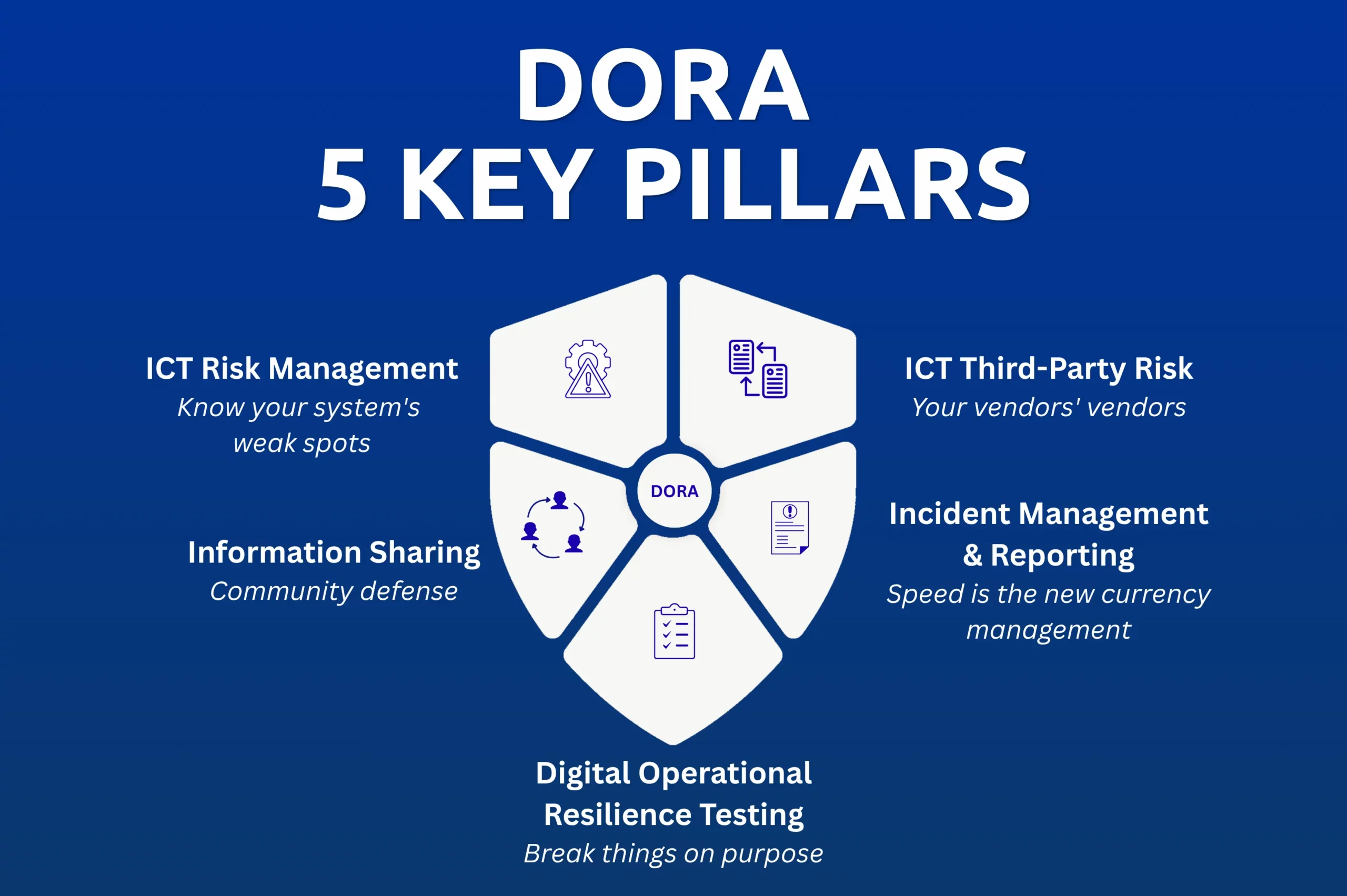
You do not need to memorize legal articles. But you do need to know what DORA demands of your cloud operations.
1. ICT Risk Management – Know Your System's Weak Spots
You must maintain a living inventory of all ICT assets that support your “critical or important functions.” For a cloud business, that means every microservice, every database, every API gateway, and every third-party API you call.
Under Article 3(22) of DORA, a “critical or important function” is defined as “a function whose disruption would materially impair the soundness or continuity of the financial entity’s services and activities, or compliance with the conditions and obligations of its authorisation”. There is no official list of what qualifies; businesses must perform their own case-by-case assessment.
2. Incident Management & Reporting – Speed Is the New Currency
DORA mandates initial major incident notification within 4 hours of classification (and no later than 24 hours from becoming aware of the incident) for financial entities. For you as a vendor, this means your monitoring stack must produce audit-ready timelines automatically and keep historical records and logs.
The full reporting timeline under DORA:
- Initial report: Within 4 hours of classification (max 24 hours from awareness)
- Intermediate report: Within 72 hours of initial notification
- Final report: Within 1 month of intermediate report
Practical example:
Imagine your platform suffers a distributed denial-of-service (DDoS) attack that takes your customer portal offline for three hours during peak business hours. Your team detects the attack at 9:00 AM and begins investigating. By 10:30 AM, after assessing the impact — over 30% of your clients affected, service downtime exceeding two hours, and an estimated economic impact over €100,000 — you classify it as a “major” incident under DORA’s criteria.
The clock now starts:
- By 2:30 PM (4 hours later): You must submit your initial notification to the competent authority with the basic facts: what happened, when, which services are affected, and your preliminary impact assessment.
- By 2:30 PM three days later (72 hours after the initial report): You submit an intermediate report with more detail. Preliminary root cause analysis, updated customer impact figures, containment actions taken, and estimated recovery timeline .
- One month after the intermediate report: You submit your final report with the full root cause analysis, total financial impact, lessons learned, and corrective actions implemented to prevent recurrence.
Important nuance: The 4-hour clock starts at classification, not detection. You have some time to investigate and determine whether the incident meets the “major” threshold. But classification must happen “without undue delay,” in practice within 24 hours of becoming aware of the incident. If you later discover that a minor incident was actually major, the 4-hour clock starts at the point of reclassification, not retrospectively.
3. Digital Operational Resilience Testing – Break Things on Purpose
Annual pen-tests are no longer enough. DORA expects continuous testing, including vulnerability assessments, network security assessments, scenario-based testing, performance testing, and end-to-end testing. For larger firms, Threat-Led Penetration Testing (TLPT) is required, which replicates tactics, techniques, and procedures of real attackers. Micro-enterprises are exempt from TLPT obligations.
Testing must be performed at least once a year on all ICT systems and applications that support critical or important functions.
4. ICT Third-Party Risk – Your Vendors' Vendors
If you use Stripe for payments, Twilio for SMS, or even a subcontracted data center (collocation), you must map that dependency and ensure they have resilience measures in place. DORA calls this the “Register of Information.” Under Article 28(5), financial entities may only enter into contractual arrangements with ICT third-party service providers that comply with appropriate information security standards.
5. Information Sharing – Community Defense
Voluntary but encouraged: sharing threat intelligence with peers under DORA Article 45 to raise collective defense. The European Supervisory Authorities (ESAs) have issued guidelines to improve coordination, oversight, and information sharing between supervisory bodies under DORA. Financial entities notify their regulators when they join such trusted communities . For cloud operators, this means participating in sector-specific information sharing networks.
For example, the European Cloud User Coalition (ECUC) is a group of 32 financial institutions that works with cloud providers and regulators to standardize security and contract requirements for the financial sector. As a cloud provider, engaging with such coalitions helps you understand your clients’ expectations and align your service with industry standards. Broader networks like sector-specific ISACs (Information Sharing and Analysis Centers) are also available across critical infrastructure sectors.
Where Most Cloud Businesses Get Stuck
From our work with European cloud-native companies, three technical gaps cause 80% of DORA pain points.
- No automated evidence collection.
Regulators want logs and full audits. DORA explicitly requires logging of events related to logical and physical access control, ICT operations (including system and network traffic activities), and ICT change management. - Legacy workloads that cannot fail over.
If you have a 10-year-old Java monolith that only runs on one old VM image in one availability zone, DORA’s recovery time objectives (RTOs) won’t be met. DORA requires entities to manage risks related to outdated, unsupported, and legacy ICT assets. - Misunderstanding the “critical function” definition.
A “critical function” under DORA is any service whose disruption would materially impair your customer’s operations. As the European Commission has clarified, this includes functions essential to compliance with legal obligations, those whose disruption could impact financial stability, and functions that cannot be readily substituted by other providers. For a logistics SaaS, that might be real-time tracking. For a healthcare platform, patient data access. You must identify yours explicitly.
How Cloudification's c12n Private Cloud Simplifies DORA Compliance
This is exactly why we built the c12n private cloud. Generic public clouds leave you holding 100% of the DORA responsibility for the OS, middleware, runtime, and application layers — while giving you limited control over the architecture. Our c12n platform shifts that model.
With c12n managed private cloud, European businesses get:
- Auditable-by-design infrastructure – Every API call and failover event is automatically logged and time-stamped for regulator-ready reporting (consistent with DORA Article 38 logging requirements).
- Clear responsibility boundaries – We provision the underlying hardware and virtualization, but you retain full control over your application layer, with contractual SLAs that match DORA’s incident timelines.
- European hosting & sovereignty – Data stays within EU jurisdiction, satisfying both DORA and emerging EU cloud certification schemes.
You focus on your application. We provide a compliant, resilient private cloud foundation.
Practical First Steps for Any European Business
You do not need a six-month consulting project. Start here:
- Map your ICT supply chain. List every cloud provider, API, and subcontractor that touches your production environments.
- Identify your top three critical functions. Apply the DORA Article 3(22) test: Would disruption materially impair your customer’s operations or legal compliance?
- Run a tabletop failure scenario. Gather your team and simulate your primary cloud region just went offline. Document who does what and how long recovery takes.
- Review your contracts. For any financial services customer, check your DORA-related clauses. Article 30 mandates termination rights for significant breaches, material changes in provider situation, or evidenced weaknesses in ICT risk management. Probably it is a good time to renegotiate if the contracts are missing those.
- Review your backup and restore automation. Can you prove, with a timestamped log, that you successfully restored a production database from backup last week? DORA requires backup policies specifying scope, frequency based on criticality, and documented restoration procedures.
Final Takeaway: DORA Is Already Here – But It Is Not Too Late to Catch Up
Let us be honest: DORA is already in effect. It has been applicable since January 17, 2025. The grace period for interpretation is long over. By now, financial entities have already filed their initial registers of information, run their first round of mandatory resilience tests, and updated their incident reporting processes.
If you are a European business that provides ICT services to financial clients — or even indirectly serves them through a supply chain — you have likely already received DORA-related contract amendments, audit requests, or security questionnaires. If you have not, you will. Soon.
Here is the good news: regulators are not looking to punish honest effort. The European Supervisory Authorities have made clear that their initial focus is on systemic risks and repeated failures, not on perfectly polished compliance from every small vendor overnight. But that window is closing.
What matters now is demonstrable progress. Can you show an auditor or a concerned financial client that you:
- Have mapped your critical functions?
- Run regular backup restoration tests (with logs)?
- Know your ICT supply chain down to all subcontractors?
- Can you notify a client of a major incident within hours, not days?
If the answer to any of these is “not yet,” you are not alone. But you are also not safe.
DORA compliance is not a punishment. It is a mirror. It shows you where your ICT operations are fragile, where your vendor management is leaky, and where your incident response is more hopeful than process. European businesses that embrace DORA heute will build deeper trust with customers, pass audits faster, and sleep better before the next cloud provider outage.
Ready to Explore Edge Kubernetes?
This article gave you the lay of the land. But knowing what DORA requires and actually building compliant infrastructure are two very different things.
At Cloudification, we help European businesses design, deploy, and operate cloud environments that meet DORA’s ICT risk management, resilience testing, and third-party oversight requirements—without the vendor lock-in or surprise bills.


