


Why the Kubernetes Gateway API is the Future of Ingress (And What You Must Do Now)
If you’ve been managing Kubernetes for any length of time, you’ve likely heard the rumblings by now: the Ingress object as we know it is entering maintenance mode. The Kubernetes Gateway API is the future of Ingress, and the ecosystem is making a hard shift. With the official retirement of the Ingress NGINX Controller set for March 31st, 2026, the training wheels are officially coming off.
But let’s be clear about what is happening. The original Ingress API isn’t vanishing overnight—you can still create Ingress resources. However, the Ingress NGINX Controller (the default implementation shipped in most distributions) will no longer receive security patches, bug fixes, or compatibility updates after March 2026. This isn’t just a vendor shuffle; it is a fundamental evolution of how Kubernetes handles inbound traffic to microservices. The community isn’t just replacing a controller; they are replacing the architecture with the Gateway API.
The End of an Era: Why Ingress is Fading Out
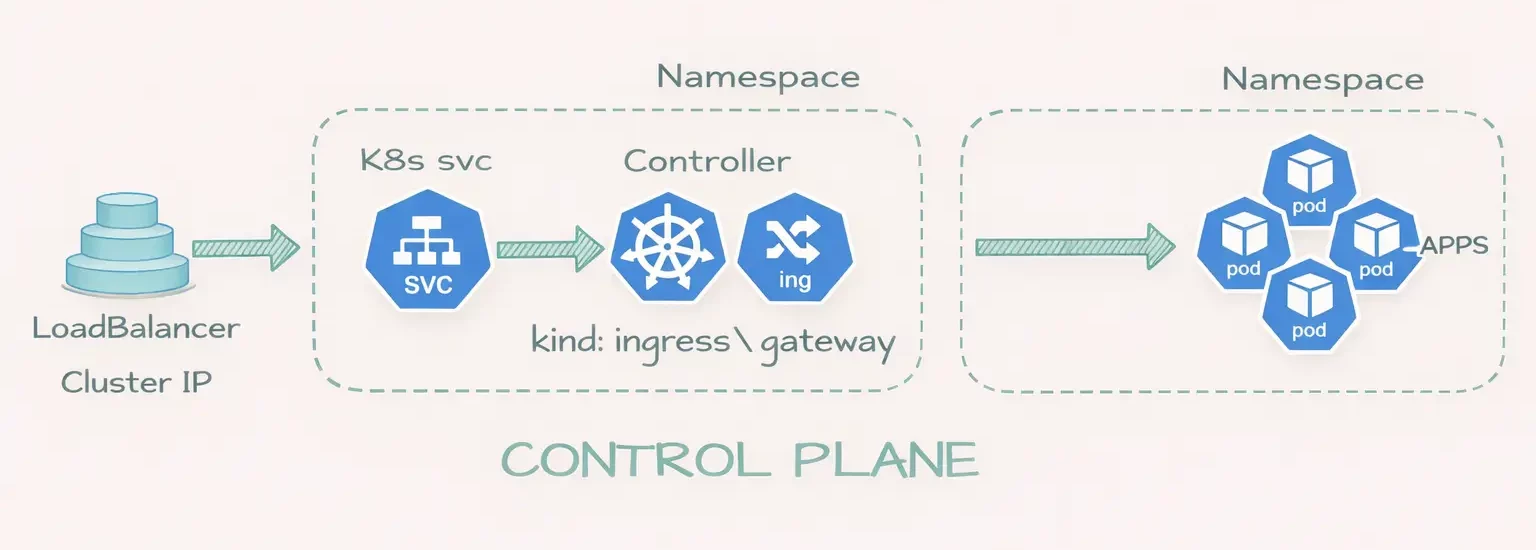
To understand why the Gateway API is taking over, we have to look at the baggage the original Ingress carries. Back in 2015, Ingress was revolutionary, but it was also simplistic. It assumed a world where a single operator managed both the network infrastructure and the applications.
As platforms scaled, that model broke. The primary pain points became undeniable:
- Annotation Sprawl: Advanced features like traffic splitting, timeouts, or CORS rules weren’t part of the Ingress spec. This forced users to rely on proprietary, string-based annotations (e.g., nginx.ingress.kubernetes.io/rewrite-target). Moving from an NGINX stack to a Traefik or AWS ALB stack meant a complete rewrite of your K8s manifests was necessary.
- Lack of Role Separation: The Ingress resource was monolithic. It forced the platform operator (who cares about the load balancer IP and TLS certs) and the application developer (who cares about URL paths and backends) to edit the same resource, often leading to configuration conflicts and the need for super-user privileges.
- Limited Expressiveness: Modern cloud-native traffic management requires canary rollouts, header-based routing, and gRPC support. Ingress couldn’t handle these natively.
The Gateway API was designed from the ground up to solve these specific issues.
Gateway API: A Role-Oriented Revolution
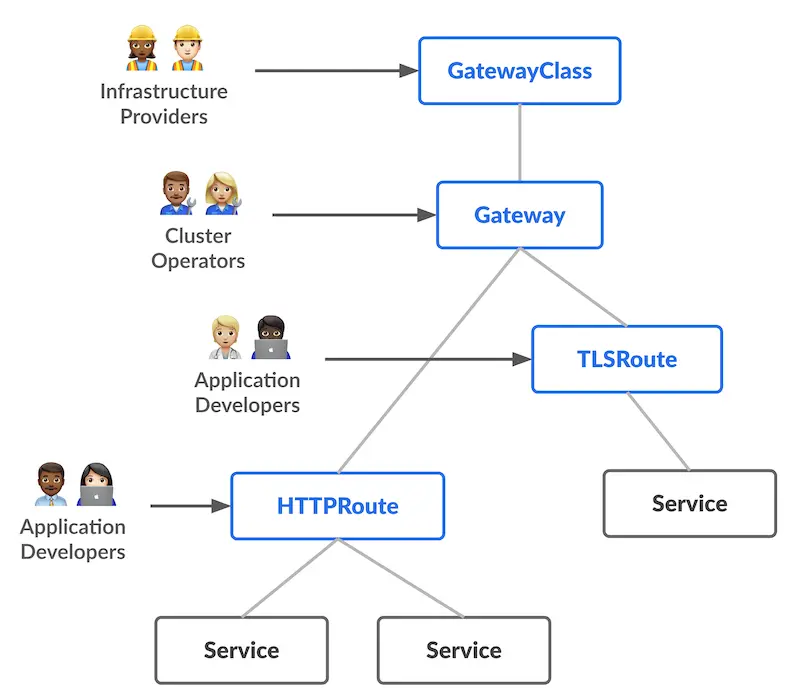
The Kubernetes Gateway API isn’t just an upgrade; it is a complete rethinking of network abstraction. It introduces a role-oriented resource model that mirrors how real engineering teams operate today.
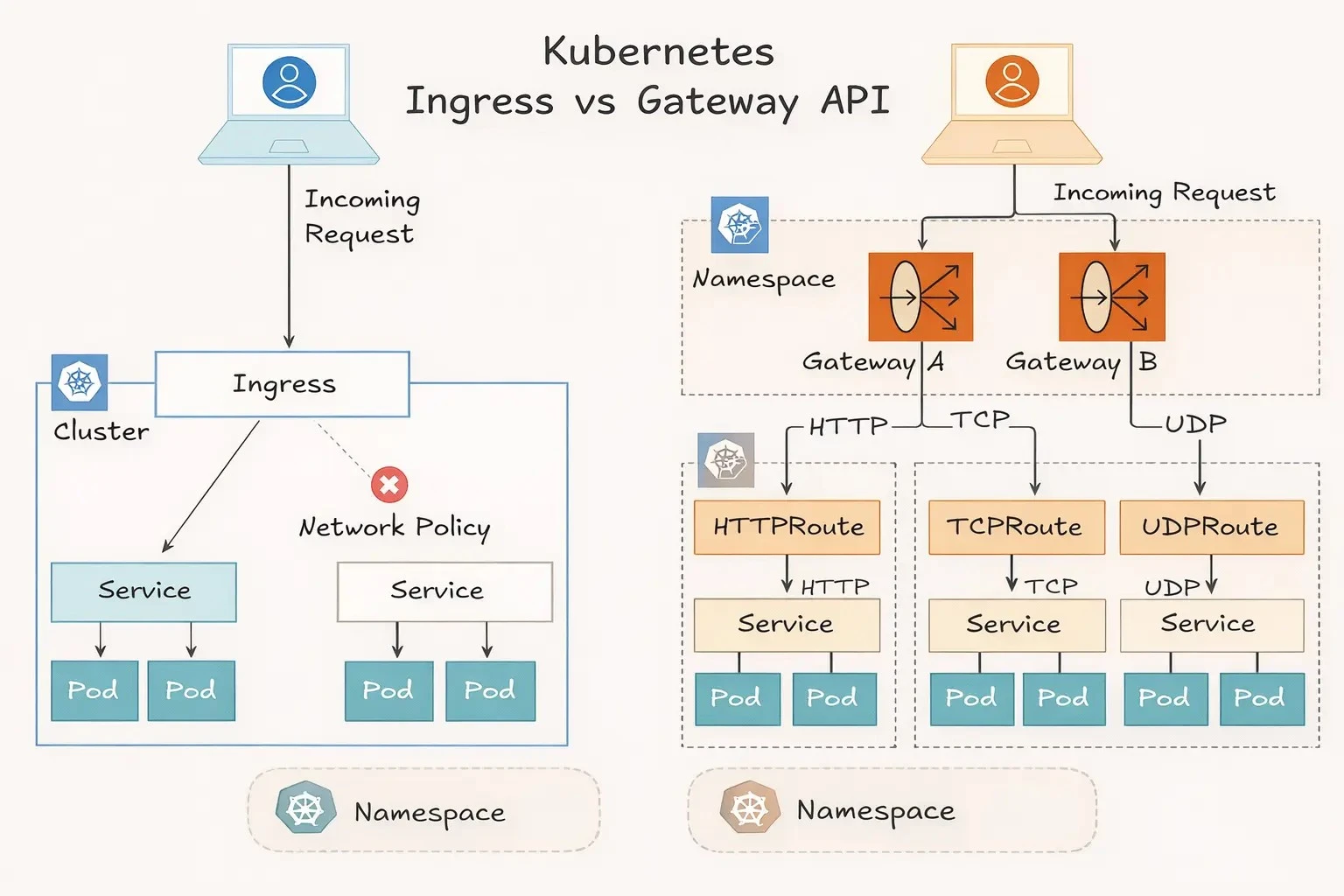
Instead of one monolithic Ingress object, the Gateway API splits responsibilities into three distinct layers:
- GatewayClass: This defines the type of controller (e.g., “nginx”, “envoy,” “aws-alb”, “traefik”). It is defined by the infrastructure provider.
- Gateway: This requests a specific point of entry (a load balancer). It defines the listeners (ports, protocols, TLS). This is managed by the cluster operator.
- HTTPRoute (or TCPRoute, GRPCRoute): This defines the routing logic (headers, paths, weighted backends). This is managed by the application developer.
This separation allows a developer to define how traffic hits their service without ever needing to know the IP address of the load balancer or the specifics of the SSL certificate in use. They simply attach their HTTPRoute to a Gateway managed by the ops team.

Ingress vs. Gateway API Comparison Table
To truly appreciate the shift, it helps to see the two APIs side by side. The Ingress API, while groundbreaking for its time, was designed with a simpler, single-operator model in mind. The Gateway API, in contrast, was built from the ground up to address the realities of modern, multi-tenant Kubernetes environments. The table below highlights the fundamental differences in architecture, audience, and capabilities—demonstrating why the Gateway API is not merely an incremental improvement, but a complete reimagining of how Kubernetes handles service networking.
| Feature | Ingress API | Gateway API |
|---|---|---|
|
Resource Model |
Monolithic (one object) |
Decoupled |
|
Target Audience |
Cluster Operator only |
Platform Ops, Cluster Ops, App Developers |
|
Extensibility |
Non-standardized Annotations |
Standardized fields & Policy Attachment |
|
Protocol Support |
HTTP/HTTPS only |
HTTP, gRPC, TCP, UDP, TLS |
|
Traffic Split |
Via vendor-specific annotations |
Native weight field in backendRefs |
|
Cross-Namespace |
Complex/Insecure |
Explicit ReferenceGrant policies |
AI and the Future: The Gateway API Inference Extension
Here at Cloudification, we are particularly excited about where the Gateway API is heading beyond basic HTTP routing. As AI inference moves into Kubernetes, the network layer must become “smarter.”
Enter the Gateway API Inference Extension (GAIE). This is an active evolution of the Gateway API designed to optimize Large Language Model (LLM) inference routing.
Standard load balancers use round-robin or least-loaded connections, which are oblivious to the state of an AI model. GAIE allows the Gateway to scrape real-time metrics from model servers (like KV cache utilization or queue depth) to make intelligent routing decisions.
Imagine a scenario where two pods serve the same LLM. If one pod has a specific prompt prefix already cached, the Gateway can route a related request to that pod to avoid expensive re-computation. Google’s GKE Inference Gateway (built on these principles) recently demonstrated that this architecture can reduce Time to First Token (TTFT) latency by 35% and double cache hit rates.
This is the power of the new API: it is built to handle the workloads of tomorrow, not just web apps and generic services.
The Migration Path: What You Need to Do Now
If your clusters are currently running the deprecated Ingress NGINX Controller, you have a decision to make. The “do nothing” approach means accepting unpatched CVEs after March 2026.
A more pragmatic path forward:
- Inventory: Run kubectl get ingress -A to see what you have. Identify which ingresses rely on NGINX-specific annotations.
- Choose an Implementation – you need a Gateway API-compliant controller. Some of the popular options:
- NGINX Gateway Fabric: For teams wanting to stick with the familiar NGINX but in a Gateway-native way.
- Envoy Gateway: A CNCF project offering high conformance and an Envoy proxy data plane.
- Istio / Cilium: If you are already in a service mesh, they offer robust Gateway implementations.
- Traefik: if you’ve been running Traefik ingress before, the chances are high that you’d want to stick with Traefik Gateway.
- Leverage Tooling: Use tools like ingress2gateway to automate the translation of your old Ingress YAMLs into new Gateway and HTTPRoute manifests.
- Adopt a more careful approach: Run your new Gateway controller alongside your old Ingress controller. Migrate namespace by namespace, validating traffic flows before cutting over entirely.
The official Kubernetes documentation provides a comprehensive guide for migrating, which includes a manual conversion example and links to the official ingress2gateway tool. Check it out hier.
Future-Proofing Your Infrastructure
Transitioning to the Gateway API isn’t just about keeping the lights on; it is about unblocking your developers and preparing for the next wave of AI-native applications.
At Cloudification, we understand that infrastructure should be an enabler, not a bottleneck. Don’t get left behind maintaining legacy, unpatched controllers. Build a cloud that evolves with the ecosystem.
Is your team ready to move beyond Ingress and embrace the future of Kubernetes networking?
Contact us today to discuss how we can help you modernize your infrastructure.


