Multi-Data-Center Private Cloud for VMware and OpenShift Replacement
A unified private cloud platform across three data centers for virtualized and containerized workloads.
Company
German · 10 000+ employees
A large German healthcare company with more than 10,000 employees. Its infrastructure included VMware and OpenShift clusters used for different types of workloads.
The project focused on moving to a new private cloud platform and covered infrastructure across three data centers.
Challenge
The customer needed a new private cloud platform that could be used to replace the existing VMware clusters. One of the goals of the transition was to reduce the total cost of ownership (TCO) of the infrastructure.
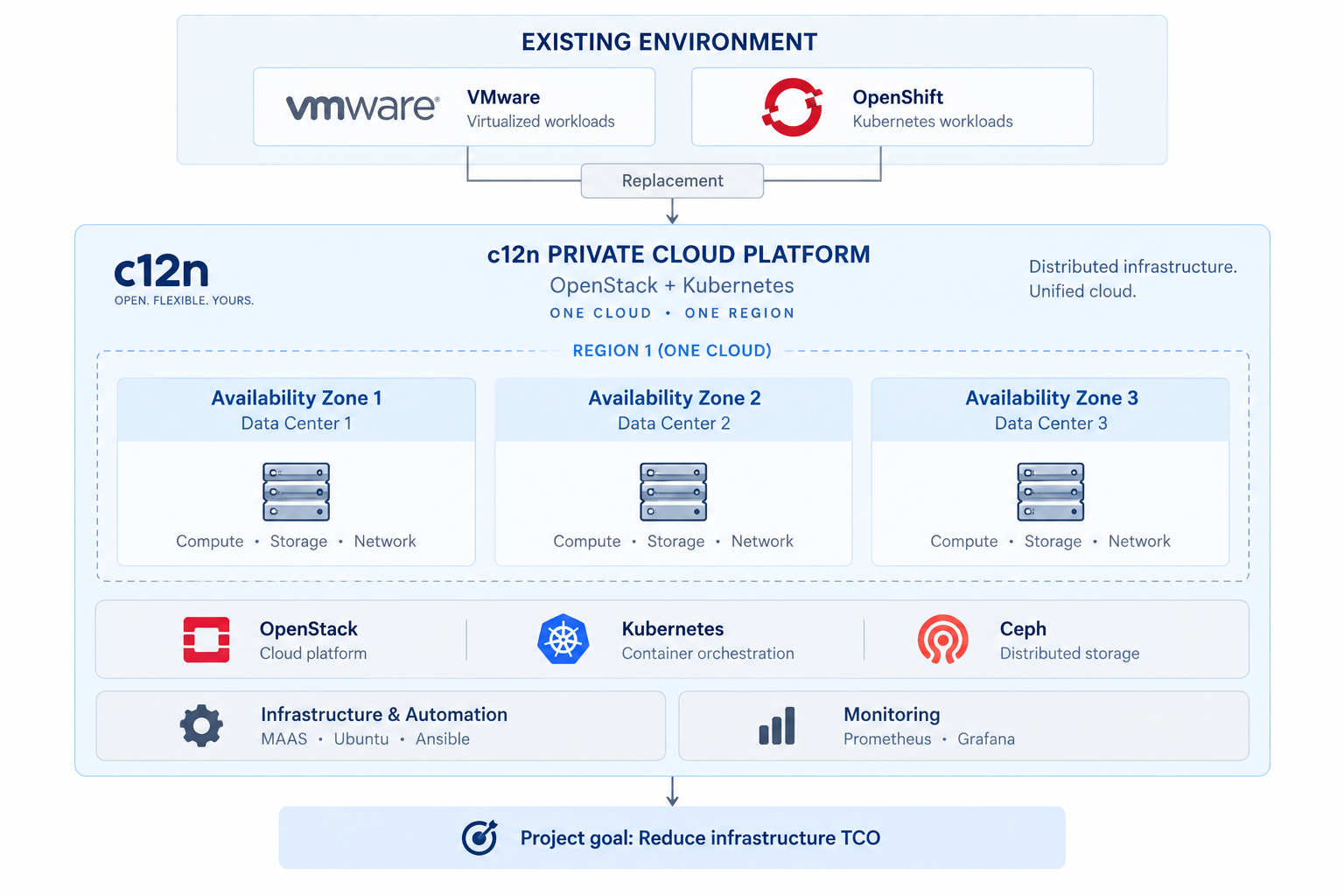
The project was not limited to a single cloud environment. The new platform had to be deployed across three data centers, using OpenStack and Kubernetes as the foundation for virtualized and containerized environments.
The project therefore affected two existing technology areas at once: VMware for virtualized infrastructure and OpenShift for the KaaS environment.
KEY CHALLENGE
Replace VMware and OpenShift with a unified private cloud across three data centers while reducing the total cost of ownership.
Project specifics
The new architecture had to support both virtualized workloads previously running on VMware and the containerized environment previously orchestrated by OpenShift.
Another important aspect was the deployment of several private clouds stretched across three data centers. The project therefore went beyond building a single local cloud environment and involved multiple deployments based on the same OpenStack, Kubernetes, and c12n.cloud technology stack.
The technology stack also included Ceph, MAAS, Ubuntu, and Ansible at the infrastructure level, with Prometheus and Grafana used for monitoring and visualization.
Solution
Cloudification deployed several private clouds based on OpenStack and Kubernetes using c12n.cloud. The new platform was deployed across three data centers and was intended to replace the existing VMware and OpenShift clusters.
OpenStack was used as the foundation of the cloud infrastructure, while Kubernetes provided the container platform. This approach brought virtualized and Kubernetes workloads onto a new technology stack instead of maintaining separate VMware and OpenShift platforms.
Ceph was also included in the infrastructure stack to replace vSAN and Netapp filers used by VMware. MAAS, Ubuntu, and Ansible were used for infrastructure deployment and management.
Prometheus and Grafana were included for monitoring and visualization. The project therefore covered not only the core OpenStack and Kubernetes components, but also the tools required for deployment, automation, and monitoring of the new cloud environment.
Another important characteristic of the project was its deployment mode: the same technology foundation was used to deploy several private cloud environments stretched across three data centers with low-latency fiber links in-between.
Result
As a result, the customer received three production-ready private cloud platforms based on OpenStack and Kubernetes, deployed across three data centers in a matter of weeks.
The new infrastructure became the platform for replacing the existing VMware and OpenShift clusters and was built with the goal of reducing the overall total cost of ownership.
Three Private Cloud Platforms Deployed
OpenStack and Kubernetes infrastructure across three data centers, replacing VMware and OpenShift and supporting the transition to a lower-TCO platform.