


GitOps for Private Cloud Operations: How to Automate, Secure, and Scale Your Infrastructure
Private cloud environments are powerful, but operating them at scale can quickly become complicated. If you manage a private cloud, you already know the drill. Configuration drift creeps in. Manual changes slip through the cracks. Auditors ask for evidence you can’t easily provide. And somehow, despite doing automation, your team still spends way too much time firefighting instead of building.
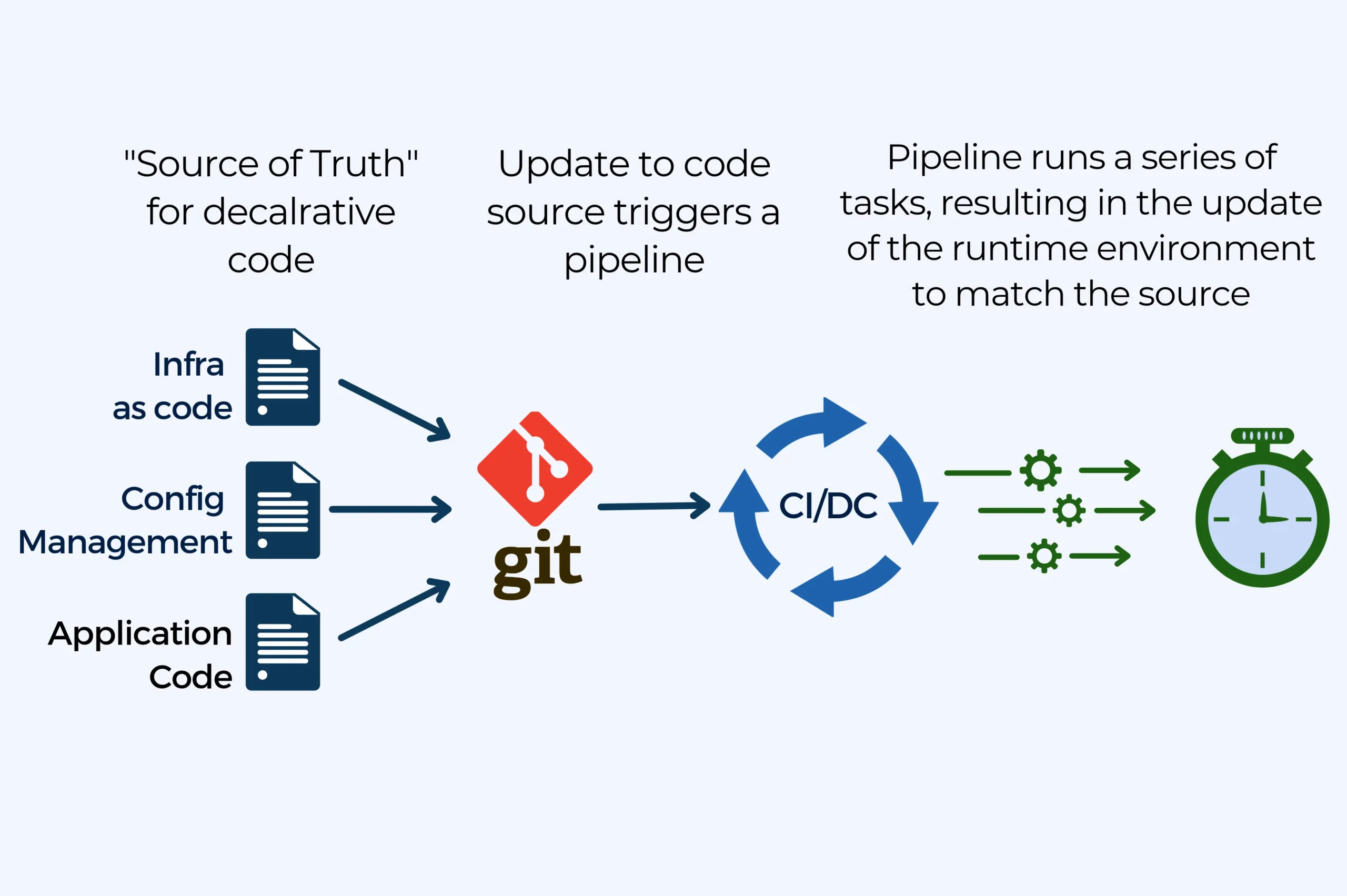
GitOps fundamentally changes operations, not by adding another tool to your stack, but by rethinking how infrastructure should be managed in the first place. GitOps treats infrastructure configuration like software: everything is declared, version-controlled, reviewed, automated, and continuously reconciled. Instead of relying on engineers to remember which servers, clusters, networks, or services need updating, Git becomes the single source of truth, and automation keeps the actual environment aligned with the desired state.
Think of it as applying the same discipline we use for application code to the infrastructure itself. Every change is reviewed with 4-eyes principle, every state is versioned, and your infrastructure constantly reconciles itself toward a desired state defined in Git. This approach is increasingly relevant as organizations modernize their IT infrastructure with Kubernetes as the leading container management platform. According to Research and Markets, the GitOps and Infrastructure as Code software market is projected to grow from USD 1.96 billion in 2025 to USD 6.40 billion by 2031, at a CAGR of 21.8%. GitOps adoption has reached 64%, with 81% of adopters reporting higher infrastructure reliability and faster rollbacks.
But what does this actually mean for your Day-2 ops? Let’s break it down.
What Is GitOps?
At its simplest, GitOps means using Git as the authoritative source for an environment’s desired state and using automation to continuously make the actual environment match that state.
GitOps is an operational framework that applies DevOps best practices (version control, collaboration, compliance, and CI/CD) to infrastructure automation:
The OpenGitOps specification, maintained by the CNCF, defines four core principles:
- Declarative: The entire system’s desired state is expressed declaratively
- Versioned and Immutable: Desired state is stored in Git, enforcing immutability and retaining complete version history
- Pulled Automatically: The system automatically pulls the desired state from Git
- Continuously Reconciled: The system continuously reconciles actual state with desired state
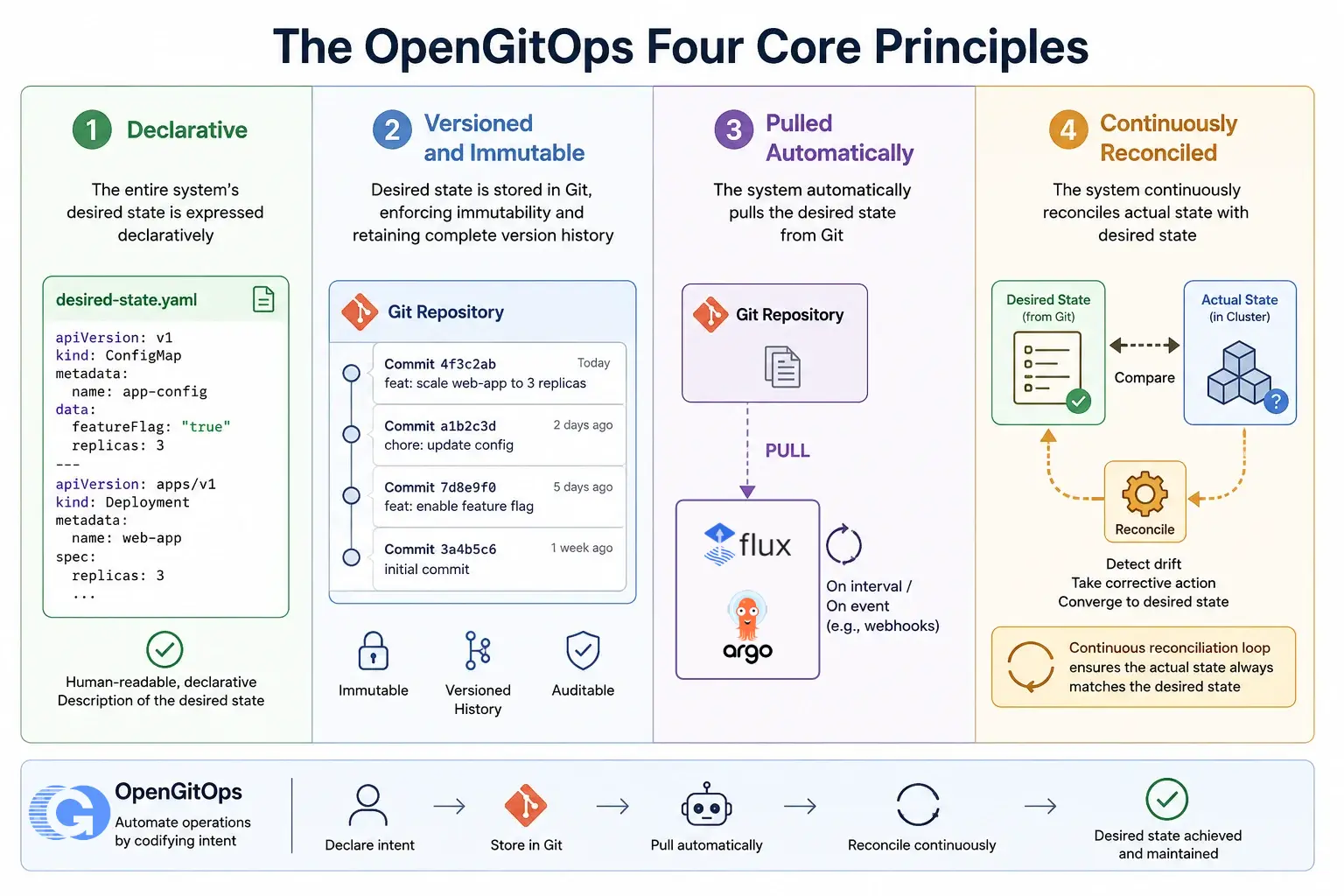
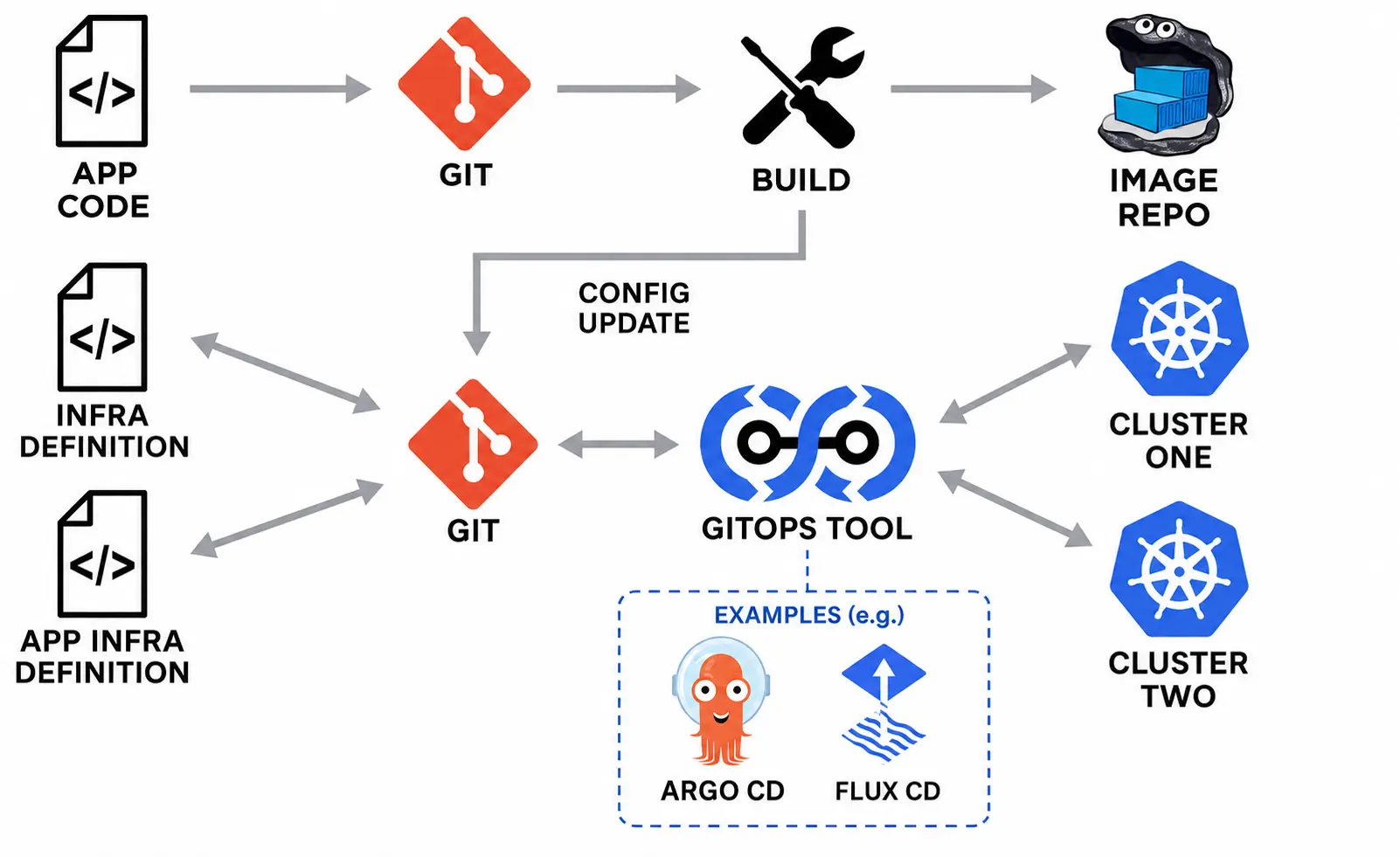
In practice, this means your infrastructure configuration (Kubernetes manifests, volume claims, ACL configuration, and pretty much everything) lives in a Git repository as code. When someone wants to make a change, they open a pull request. The pipeline plans the change, a reviewer approves it, and the pipeline applies it.
Without GitOps, an infrastructure team might manually deploy individual components or apply one-time configuration changes. One engineer changes a configuration on Monday, another makes a different change on Wednesday, and six months later nobody is even sure why the production environment looks the way it does.
With GitOps, the blueprint is stored in Git. A change to the blueprint goes through a review process, and automation makes sure the building matches the approved design.
If someone changes something manually, the difference can be detected as configuration drift and, depending on the desired policy, automatically reconciled back to the state in Git.
That simple idea becomes extremely powerful when applied to complex private cloud infrastructure.
Traditional CI/CD vs. GitOps: A Comparison
| Aspect | Traditional Operations with CI/CD | GitOps |
|---|---|---|
|
Source of Truth |
Running system |
Git repository (declarative) |
|
Deployment Model |
Push-based (CI/CD pushes changes to different ENVs) |
Pull-based (cluster pulls from Git) |
|
Change Process |
Manual (CLI/UI) changes or push based IaC (e.g. Ansible) |
Pull requests + code review. Manual changes are forbidden. |
|
Drift Detection |
Manual or requires additional monitoring tools |
Continuous detection and (optionally) reconciliation |
|
Rollbacks |
Complex, often manual |
Simply Git commit revert |
|
Audit Trail |
Scattered logs across systems |
Complete Git history |
|
Security Model |
CI/CD system holds credentials |
Cluster pulls from Git. Can be configured to ignore unsigned commits. |
|
Automation Level |
Can be high, but requires additional tools, drift detection and reconciliation mechanisms, etc. |
Up to 100% |
Traditional CI/CD pipelines are imperative: they run scripts that say “take this artifact and deploy it.” The pipeline finishes green, and the job is done. If someone manually Up to 100% changes a replica count or edits a ConfigMap five minutes later, the pipeline has no awareness of that drift. Of course, one could restrict access to only a few trusted people, but the human factor will still be there. Also, it is not always the human operator who causes the drift, application bugs and vulnerabilities can be a cause too.
GitOps, by contrast, is declarative. You don’t tell the CI/CD system how to deploy; you tell it what the final state must look like. A tool like ArgoCD or Flux runs inside your infrastructure, continuously monitoring the Git repository and reconciling the live state against the desired state.
The shift from push to pull is more than a technical detail; it’s also a security game-changer. In traditional setups, your CI/CD system holds the “keys to the (production) kingdom,” with write access to production clusters. In GitOps, the deployment agent (e.g., ArgoCD) runs directly in the cluster and regularly pulls from Git.
How GitOps Transforms Private Cloud Operations
The biggest change is not the Git repository itself, it is the operational feedback loop.
Imagine that your cloud has 20 Kubernetes clusters. A traditional workflow might look like this:
DevOps Engineer → CI/CD pipeline → K8s cluster → K8s reconciliation to the state declared by K8s manifests
The engineer changes Helm values, the pipeline runs helm install or upgrade, and the operation is considered finished when the exit code is 0. But a successful deployment doesn’t guarantee the same state will be preserved after the deployment. Another engineer might make manual changes to Kubernetes manifests or even roll back via Helm.
A GitOps workflow looks like this:
DevOps Engineer → Git PR → Git Review and merge → GitOps controller → K8s cluster → Continuous reconciliation to the state declared in Git
The controller remains active after the deployment, comparing the desired configuration with the actual state and taking action when they differ.
That is why tools such as Argo CD and Flux have become essential in the cloud-native ecosystem. CNCF’s 2025 ArgoCD End User Survey reported that ArgoCD was being used for application delivery in nearly 60% of the Kubernetes clusters represented by survey respondents.
1. Eliminating Configuration Drift
Configuration drift is the silent killer of environment stability. A manual tweak here, an emergency patch there, and over time, environments diverge. Troubleshooting why things work on one VM but not on another becomes guesswork. GitOps eliminates that by continuously reconciling toward a known, versioned state.
2. Making Compliance an Artifact
In regulated industries, providing compliance evidence is often harder than achieving it. Auditors want to see who changed what, when, and why.
GitOps turns compliance into a feature. Every change has a commit history (of course, one still has to write proper commit messages). Every deployment has a PR with reviews and approvals. Tools like Argo CD provide out-of-the-box RBAC, audit logs, and integration with secret managers or encryption tools like git-crypt and SOPS. The concept of an “evidence locker” (an immutable store of vulnerability scans, build logs, sync statuses, and deployment results) makes audit readiness continuous with clear, documented evidence.
3. Enabling Secure Self-Service Without Chaos
Platform engineering teams face a constant tension: give developers self-service access without losing control. GitOps resolves this by making Git the interface for infrastructure changes.
In a traditional environment, administrators may require direct access to production systems to make changes. The more people and automation systems with privileged access, the larger the potential attack surface and the higher the chance of credential leaks. GitOps can reduce the need for direct access.
Instead of giving every operator permission to modify production infrastructure, teams can make changes through Git. Pull or merge requests provide an opportunity for 4-eyes peer review, automated syntax checks, sanity checks with protected branches, and approval before the change reaches production or any other environment.
This creates a useful separation:
People propose changes → Automation validates changes → Approved automation applies changes.
It also creates a durable audit trail. Every approved infrastructure change can be associated with a Git commit, author, review, and timestamp.
That said, GitOps should not be considered a complete security solution by itself. Secrets management, identity, access control, image security, vulnerability scanning, network security, and policy enforcement still need to be designed separately.
That is where Policy as Code becomes increasingly important. Tools such as Open Policy Agent (OPA) and Kyverno can be integrated into cloud-native workflows to enforce security and compliance rules automatically.
4. Streamlining Day-2 Operations
The real cost of complex cloud operations isn’t Day-1 provisioning; it’s Day-2 operations: scaling, patching, upgrades, and capacity optimization.
GitOps automates the full lifecycle. Day-0 setup, Day-1 provisioning, and Day-2 operations become repeatable, predictable workflows. Tasks like scaling or patching are stitched into automated workflows triggered by events, schedules, or performance thresholds. Instead of discrete tasks, these activities become part of a continuous operational cadence that keeps environments healthy with minimal human intervention.
GitOps and Platform Engineering Go Hand in Hand
Platform engineering is another reason GitOps is gaining traction. Platform teams build internal platforms that let application and development teams consume infrastructure without understanding every underlying component.
A developer should ideally not need to know how the underlying Kubernetes storage is configured, how OpenStack networking is implemented, or how Kubernetes control-plane components are maintained just to deploy an application.
The platform team can provide a standardized path, and GitOps becomes the automation layer underneath that platform.
For example:
- Developers request an environment for a new application
- Platform engineer prepares configuration
- Git change is created, reviewed and merged
- GitOps controller applies the changes and creates the environment
- Developer receives a ready-to-use environment.
This creates a standardized, automated way of consuming infrastructure.
What Does GitOps Look Like in a Private Cloud like c12n?
Consider a company operating an OpenStack-based private cloud with Kubernetes on top.
The environment might include:
- Bare-metal provisioning
- OpenStack compute and networking
- Ceph storage
- Kubernetes clusters
- Kubernetes applications
- Monitoring and alerting
- Centralized logging
- Security policies
Instead of treating these as isolated systems, the organization can define their desired configuration as code and manage changes through a Git-based workflow.
A developer or platform engineer submits a change. The change is reviewed, validated, and approved. Automation applies it. GitOps controllers continuously monitor the environment. Monitoring and logging provide feedback. If the environment drifts, the team detects and optionally reconciles it.
This creates a closed operational loop:
Git → automation → infrastructure → observability → reconciliation → Git.
That is the real power of GitOps for private cloud operations.
How c12n Uses GitOps to Automate Private Cloud
This is also where GitOps becomes particularly interesting for c12n Private Cloud.
c12n Private Cloud is Cloudification’s open-source-based private cloud platform, combining OpenStack, Kubernetes, Ceph, MAAS, Argo CD, Prometheus, and OpenSearch. The platform is designed around automation, Kubernetes, cloud-native technologies, and GitOps.
The goal is not simply to install a private cloud once.
The goal is to make the private cloud repeatable and operationally manageable.
With c12n, the entire GitOps configuration can live in the customer’s own Git repo and infrastructure. That’s especially valuable for organizations with strict security or air-gapped requirements.
In practice, GitOps helps turn private cloud operations from a collection of manual admin tasks into a controlled software lifecycle. That’s a major shift.
GitOps Is Not a Magic Button
GitOps introduces significant benefits, but it also requires discipline.
Teams need to decide how repos are structured, how environments are separated, how secrets are managed, who can approve production changes, how emergency changes are handled, and which resources should be automatically reconciled.
There’s also a difference between “everything is in Git” and genuine GitOps. Storing YAML in a repo doesn’t make it GitOps-managed—you need the full framework.
And don’t forget observability. Automation makes changes faster, but you still need monitoring, logging, metrics, alerting, and clear procedures.
The Future of GitOps in Private Cloud
GitOps is moving beyond application deployment. The combination of GitOps, Kubernetes, Infrastructure as Code, Policy as Code, observability, and platform engineering is creating a broader model for operating cloud infrastructure.
For private clouds, this is especially significant. Organizations increasingly want the automation and developer experience of public cloud while retaining control over infrastructure, data, location, security, and costs. GitOps bridges those goals.
Instead of treating a private cloud as a static collection of servers, you can operate it as a continuously managed, versioned, software-defined platform. And as private cloud environments become more distributed (across multiple data centers, edge locations, and sovereign infrastructure), the ability to reproduce and continuously reconcile environments becomes even more valuable.
GitOps Turns Private Cloud Into a Software-Managed Platform
The biggest change GitOps brings is a mindset shift.
Infrastructure stops being something engineers configure once and maintain manually. It becomes something that is declared, reviewed, automated, observed, and continuously reconciled.
For small environments, the difference may initially seem modest. But for a private cloud spanning dozens or hundreds of nodes, multiple Kubernetes clusters, distributed storage, several data centers, or regulated workloads, the difference can be enormous.
That is why GitOps is becoming a foundational practice in modern cloud-native operations. And for organizations building their own private cloud, the question is increasingly not “Should we automate?” but rather:
“How much of our cloud can we make reproducible, observable, and continuously reconciled?”
With a platform such as c12n Private Cloud, Cloudification applies this philosophy directly to private cloud infrastructure, combining open-source technologies with automation and GitOps to create a cloud platform that is designed to be operated rather than manually maintained.
Ready to Automate Your Day-1 Deployment and Day-2 Ops?
If you’re building a private cloud, replacing legacy virtualization infrastructure, or looking for a more automated way to operate Kubernetes and OpenStack, c12n Private Cloud can provide a production-ready foundation based on open-source technologies and GitOps.
Explore c12n Private Cloud or contact Cloudification to discuss how GitOps can be applied to your infrastructure.
Build your private cloud. Put it in Git. Automate the rest.


