Let’s take a closer look at c12n components:
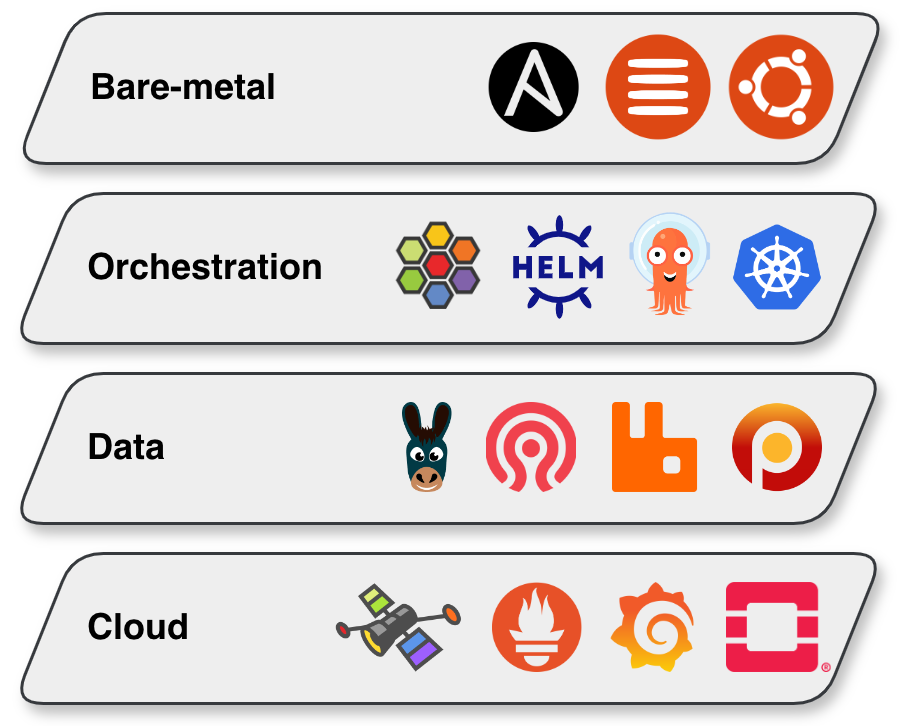
MAAS (Metal as a Service) handles the automation of physical server management, allowing for efficient resource pooling and provisioning. It allows automatic hardware discovery, firmware updates and base OS installation. Need to manage a dynamic data center? MAAS makes it easy.
Kubernetes (K8s) is the most popular container orchestration platform globally, automating the deployment, scaling, and management of containerized applications. It’s the backbone of cloud-native development, trusted by over 5 million users worldwide.
Ceph provides scalable, software-defined storage that supports object, block, and file storage on a unified distributed cluster. Ceph allows the management of multiple classes of devices (HDD, SSD, NVMe) in one cluster, with flexible configuration of topologies, replication factors and more. It’s highly resilient and is used in nearly half of all OpenStack deployments.
OpenStack is the most popular open-source platform for building and managing cloud infrastructure, offering flexibility and extensive support for multi-vendor hardware setups. It’s perfect for those looking to deploy infrastructure-as-a-service (IaaS) environments.
Gardener (KaaS) automates the management of Kubernetes clusters, ensuring they are consistently up-to-date and running smoothly. It simplifies maintaining homogeneous clusters across various infrastructures, including OpenStack.
These technologies work together within c12n to deliver a fully integrated and automated cloud platform. With GitOps, we’ve automated the deployment and operation of the platform, ensuring a seamless and declarative configuration using a state of the art approach. Monitoring and logging are handled by Prometheus and OpenSearch, providing real-time insights into cloud performance and reliability through hundreds of metrics and Grafana dashboards.
In summary, c12n provides a level of flexibility, scalability, and transparency that surpasses most of the solutions available on the market.