


Sonatype Nexus Repository: The Foundation of a Secure Software Supply Chain for Private Cloud and Kubernetes
If you manage a software delivery pipeline, you know the chaos that ensues when artifacts are scattered across public registries, shared drives, and individual S3 buckets. Modern software development depends on far more than source code. Every application is built from thousands of dependencies, container images, libraries, packages, and deployment artifacts.
Sonatype Nexus Repository has become one of the industry’s most trusted artifact repository managers because it provides a centralized platform to securely store, cache, manage, and distribute these software components across the entire software delivery lifecycle. Whether you’re running Kubernetes, developing microservice-based software, building a private cloud, or supporting air-gapped environments, Nexus Repository plays a critical role in creating a reliable and repeatable software delivery pipeline, acting as a single source of truth for your artifacts.
What Is Sonatype Nexus Repository?
Think of Nexus Repository as a large manufacturing plant of your software supply chain. An artifact repository is the warehouse that stores every finished component before it reaches production. Just as the warehouse holds the merchandise, Nexus holds, secures, and distributes your software artifacts, which include:
- Docker (OCI) container images
- Helm charts
- Maven projects
- npm
- PyPI
- NuGet
- Go modules
- RubyGems
- Yum/APT repositories
- AI/ML models and Hugging Face packages
But why does a DevOps platform need an artifact repository? Well, without that warehouse, every deployment would need to download components from the Internet, creating additional risks:
- External repositories may become unavailable.
- Package versions may change unexpectedly (new added, old gone).
- Builds become slower and less predictable.
- Security and compliance is harder to enforce.
An artifact repository solves these challenges by becoming the organization’s single source of truth for software artifacts. This is especially important as software supply chain attacks continue to target trusted open-source packages, developer tooling, and software distribution channels.
High-profile incidents such as the XZ Utils backdoor (2024), which nearly introduced a malicious backdoor into major Linux distributions, and the tj-actions GitHub Action compromise (2025), which exposed CI/CD secrets across thousands of repositories, demonstrate how trusted components can become attack vectors. These incidents reinforce the need for organizations to control where their dependencies, container images, and build artifacts come from rather than relying directly on public repositories. An internal artifact repository such as Sonatype Nexus Repository provides a trusted source for approved software components, helping improve both security and operational resilience.
Nexus Repository Architecture - Under the Hood
Nexus Repository supports three repository types:
- Hosted repositories are your private vaults – the authoritative location where you normally store internally developed artifacts.
- Proxy repositories – act as smart caches that pull from public registries (like Docker Hub or Maven Central) and store copies locally, reducing use of traffic and external dependencies.
- Group repositories are the distribution hubs – they aggregate multiple repositories behind a single URL, simplifying client configuration.
This three-tier architecture means your developers and CI/CD pipelines pull from a single source, regardless of whether the artifact is internal, external, or cached.
Nexus Repository’s architecture was designed for flexibility and scale. At its core, it runs on the Java platform with an embedded Jetty web server. The latest versions have upgraded to Java EE 10, modernizing the servlet infrastructure and aligning with current enterprise standards.

The Three Deployment Layers of Nexus Repository
Sonatype’s reference architectures break Nexus deployments into three distinct layers:
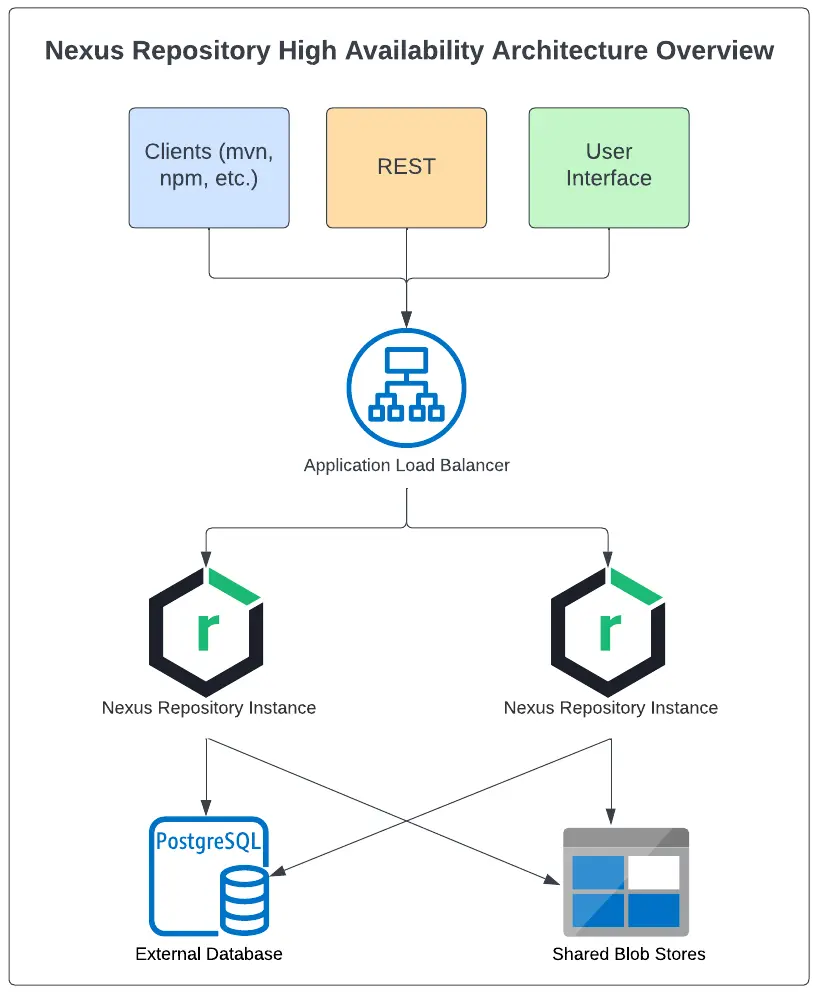
Compute Layer – This is where the Nexus Repository application runs itself, processing artifact uploads, downloads, and metadata operations. In a single-node setup, you might run this on a machine with 4 vCPU and 8-16GB RAM. At enterprise scale, a clustered deployment might include 2-4 nodes with 48 vCPU and 192GB RAM each handling 10.000+ requests per second.
Database Layer – Nexus stores repository configuration and metadata in a SQL database. For non-production environments, it can use an embedded H2 database. For production and high-availability deployments, it requires an external PostgreSQL database configured as a highly available cluster.
Storage Layer – Binary artifacts are stored in blob storage. This can be local filesystem storage, network-attached storage, or cloud-native object storage like AWS S3. The storage layer is where your container images, packages, and all other artifacts actually live.
The Proxying Mechanism
One of Nexus Repository’s most powerful features is its smart proxying. When a client requests an artifact from a proxy repository, Nexus checks its local cache first. If the artifact isn’t there, it fetches it from the remote repository, stores a copy, and serves it to the client from the cache. Subsequent requests for the same artifact are served instantly. This is especially helpful in distributed and containerized environments where the same packages or container images are often downloaded to each worker node.
Nexus Repository OSS vs Pro: Which One Do You Need?
Sonatype offers Nexus Repository in two primary self-hosted editions: Community Edition (OSS) and Professional (Pro). Let’s see how those differ.
Nexus Repository OSS (Community Edition)
The open source version is completely free to download and use. It includes:
- Universal support for Maven, npm, PyPI, Docker, and many other formats
- Private hosted repositories for internal artifacts
- Smart proxying and caching of public repositories
- Global component search across all repositories
- Role-based access controls (RBAC)
- REST APIs for automation
- Automated cleanup policies
- Community support
Recent Community Edition releases have also added previously Pro-only features including Kubernetes compatibility, external PostgreSQL database support, and new formats like Cargo (Rust), Composer (PHP), and Hugging Face.
Nexus Repository Pro (Enterprise)
The Professional edition builds on the OSS foundation with additional, enterprise features:
| Feature | Nexus OSS | Nexus Pro |
|---|---|---|
|
Docker Registry |
✅ |
✅ |
|
Maven / npm / PyPI |
✅ |
✅ |
|
Proxy Repositories |
✅ |
✅ |
|
Hosted Repositories |
✅ |
✅ |
|
REST API |
✅ |
✅ |
|
Role-Based Access Control |
✅ |
✅ |
|
High Availability |
❌ |
✅ |
|
SAML / Enterprise Authentication |
❌ |
✅ |
|
Repository Health Reporting |
❌ |
✅ |
|
Enterprise Support |
❌ |
✅ |
|
Staging & Build Promotion |
❌ |
✅ |
|
Audit Logging |
Basic |
Advanced |
The High Availability Difference
The most significant Pro feature for production environments is High Availability (HA) clustering. In an HA deployment, multiple Nexus nodes share a common database database and blob storage. If one node fails, others keep working. This ensures your CI/CD pipelines maintain uptime even during hardware failures or maintenance.
Pro also enables rolling upgrades, meaning you can upgrade Nexus without downtime by updating nodes one at a time.
For development, testing, and small teams, Nexus OSS is often sufficient. It’s free, feature-rich, and supports the most popular formats.
For large enterprise environments where even short downtime is unacceptable (or SSO integration is required) Nexus Pro will be a preferred choice.
Sonatype Nexus Repository vs JFrog Artifactory: Which Artifact Repository is better?
When evaluating artifact repository managers, Sonatype Nexus Repository and JFrog Artifactory are usually the two leading options. Both products help organizations manage software artifacts, container images, and package repositories, but they take slightly different approaches and are often chosen based on organizational needs, ecosystem, and scale.
JFrog Artifactory is the product of the JFrog Platform, a universal binary repository manager that supports over 40 package technologies. It positions itself as a complete software supply chain platform that encompasses security scanning (via JFrog Xray), CI/CD integration, and even AI/ML model management. In 2026, Artifactory became the first universal artifact management solution to natively support ML models alongside traditional packages, allowing teams to version, scan, and distribute PyTorch models the same way they handle Docker images or Maven dependencies.
Sonatype Nexus Repository, on the other hand, takes a more focused approach. It’s a repository manager first and it is excellent at what it does. Focusing on simplicity, reliability, and software supply chain management, it provides an intuitive repository manager that integrates well into Kubernetes, CI/CD pipelines, and cloud environments.
It has deep roots in the Maven ecosystem and a strong open-source community. While Nexus has expanded its format support significantly in 2026 (adding Terraform, Swift, Conda, Dart, and more), it remains a more purpose-built tool rather than a universal DevOps platform.
For many infrastructure teams, the decision comes down to whether they need a standalone, highly capable repository manager or a complete software delivery platform.
| Feature | Sonatype Nexus Repository | JFrog Artifactory |
|---|---|---|
|
Supported Formats |
~18 formats (Maven, npm, Docker, PyPI, Helm, Go, Terraform, Swift, Conda, Dart, and more) |
40+ formats including ML models and NVIDIA NIM |
|
Open Source Edition |
✅ Community Edition |
⚠️ Community edition has limited format support; most advanced features require Pro version |
|
Enterprise Edition |
✅ Yes |
✅ Yes |
|
Docker / OCI Registry |
✅ |
✅ |
|
Helm Charts |
✅ |
✅ |
|
Maven, npm, PyPI, NuGet |
✅ |
✅ |
|
Repository Proxy & Caching |
✅ Supported |
✅ Supported |
|
Kubernetes Integration |
✅ Native |
✅ Native |
|
Air-Gapped Deployments |
✅ Supported |
✅ Supported |
|
High Availability |
✅ Pro only |
✅ Enterprise edition |
|
Security & Governance |
Excellent (especially with Sonatype Lifecycle) |
Excellent (with JFrog Xray) |
|
Ease of Administration |
⭐⭐⭐⭐⭐ |
⭐⭐⭐⭐⭐ |
|
Learning Curve |
Lower |
Higher |
|
Deployment Options |
On-prem or in Cloud (SaaS launched 2025) |
On-prem, Cloud, Multi-Cloud, Hybrid |
Neither platform is objectively “better”. They simply optimize for different priorities. Organizations looking for a lightweight, reliable, and easy-to-operate artifact repository are likely to prefer Nexus Repository, particularly when it is used primarily as a Docker registry, package repository, and dependency cache.
Organizations that want an DevSecOps platform with integrated artifact management, distribution, security scanning, release lifecycle management, and CI/CD tooling may lean toward Artifactory as part of the wider JFrog Platform.
Why Artifact Repository is Essential for Air-Gapped Deployments
Air-gapped environments are becoming increasingly common across government, defense, healthcare, finance, manufacturing and other industries.
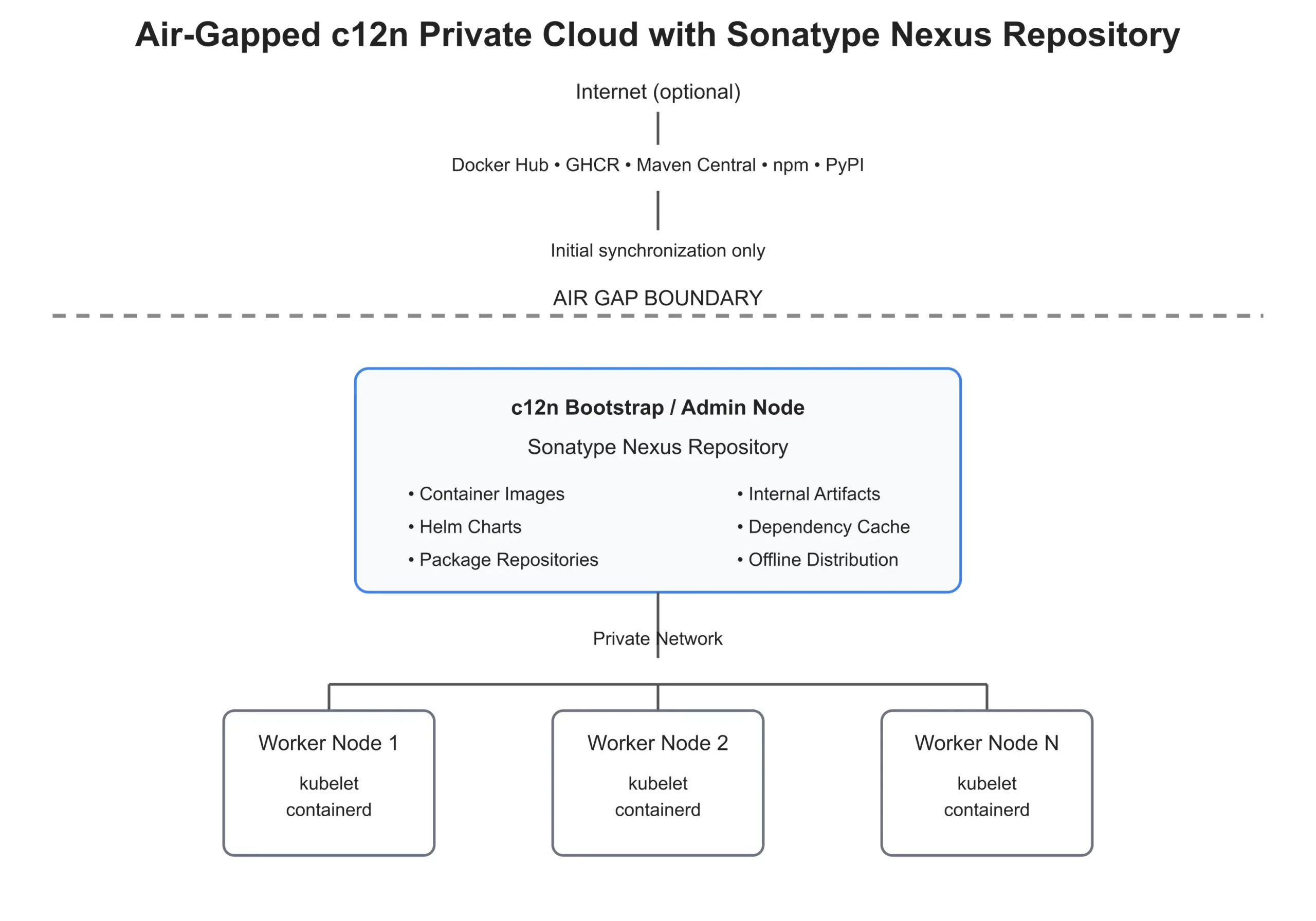
These environments intentionally have no Internet connectivity, meaning every software component must already exist inside the isolated network before deployment begins. An artifact repository is particularly valuable here because it acts as the organization’s internal software distribution hub.
Instead of manually copying packages across multiple systems, administrators synchronize approved artifacts into Nexus or Artifactory before the deployment. Once inside the isolated environment, every Kubernetes cluster, application, and CI/CD pipeline consumes software from that local repository.
For platforms like our c12n Private Cloud, this enables consistent deployments regardless of whether Internet access is available.

How We Use Sonatype Nexus in c12n.cloud
At Cloudification, Nexus Repository is a cornerstone of our c12n private cloud platform. We deploy Nexus on the bootstrap (admin) node, which acts as the first server responsible for initializing the private cloud environment and providing a source for network boot. This node serves as the bare metal management node, and Nexus acts as the artifact distribution hub for everything else that gets deployed from the base OS to Kubernetes or OpenStack.
Central Container Registry
All container images used in the cluster are stored in Nexus Repository. This includes:
- Base images (Ubuntu, Alpine, etc.)
- Operator images and Helm charts
- OpenStack service images (Nova, Neutron, Keystone, Cinder, etc.)
- OCI artifacts
Nexus Repository’s native OCI (Open Container Initiative) support means we can store and distribute standard container images, Helm charts, SBOMs, and signatures using standard OCI-compatible tools like Docker, Podman, Helm, and other.
Package Repository Hub
Beyond containers, Nexus serves as the central repository for:
- APT packages for Ubuntu/Debian systems
- YUM/RPM packages for RHEL-based systems
- Python packages via PyPI
- Ansible collections
Air-Gapped Installation Ready
For customers who operate in disconnected environments we pre-populate Nexus with all required artifacts before installing the cluster. In an air-gapped deployment:
- Container images are pre-loaded into Nexus
- Package repositories are mirrored locally
- No external internet access is required during or after deployment
- The entire private cloud can operate offline
This centralized approach ensures that neither compute, nor control plane nodes do not need direct Internet access to retrieve software packages. Instead, they consume trusted artifacts from Nexus, improving both security and deployment consistency.
Nexus Repository and Kubernetes
Kubernetes clusters continuously pull container images during application deployment. Without a local registry, every node depends on Docker Hub or another external registry. Nexus Repository acts as an internal container registry.
Benefits include:
- Faster image pulls
- Reduced Docker Hub rate-limit issues
- Deployment consistency
- Local image caching
- Support for disconnected environments
Improving Software Supply Chain Security
Software supply chain attacks continue to increase, making dependency management more important than ever. When you centralize artifact storage, you gain better control over processes such as:
- Approved package versions
- Internal package publishing
- Dependency traceability
- Artifact immutability
- Access permissions
- Audit logging
- Automated security scanning
And if you combine it with broader software composition analysis (SCA) tools, Nexus Repository becomes an important building block for secure software delivery. Features such as CVE alerts, repository health insights, and advanced governance are included in the professional version.
Conclusion
Modern infrastructure is no longer just about compute, networking and storage – it’s also about managing the software artifacts that power end-user workloads.
At Cloudification, we’ve built our c12n private cloud platform around Nexus Repository, using it on the bootstrap node to serve container images, packages, and artifacts in both connected and air-gapped environments. This architecture has proven itself in production across multiple customer deployments, providing the reliability and self-sufficiency that private cloud customers demand.
Ready to Build Your Private Cloud?
If you’re looking for a complete, self-contained private cloud solution that includes Nexus Repository as the artifact backbone, Cloudification can help. Our c12n private cloud platform delivers a turnkey private cloud experience — fully air-gapped ready, with all the artifacts you need pre-loaded and ready to go.
Contact us today to learn how we can help you build a private cloud that’s secure, self-sufficient, and built on industry-standard tools like Sonatype Nexus Repository.


