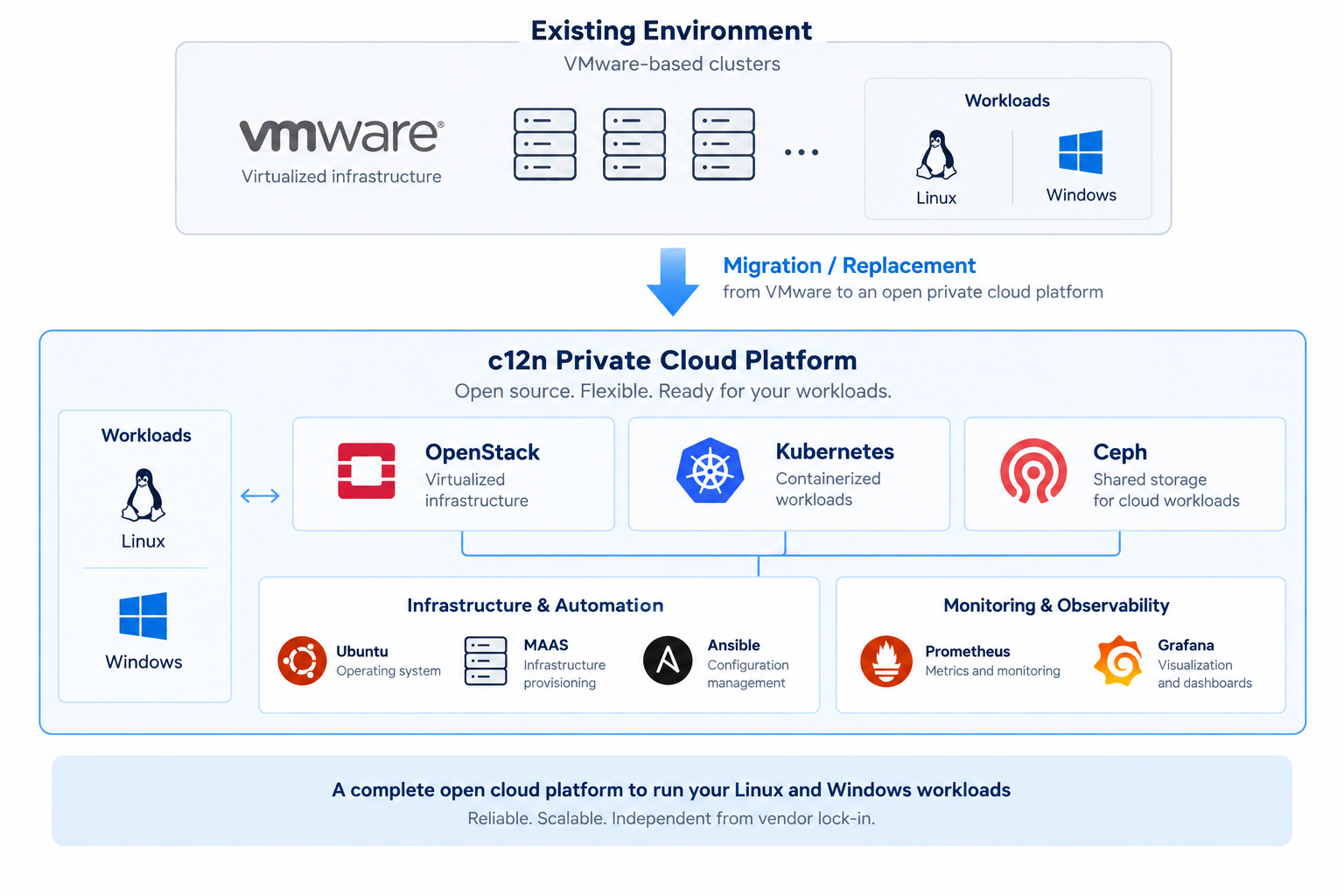
An open private cloud platform for replacing VMware and running Linux and Windows workloads.
51–100
Employees
Linux & Windows
Workloads
Company
Asia · FinTech · 51–100 Employees
An Asian FinTech company with a team of 51–100 employees. The company had been using VMware clusters to run its workloads but began moving toward an alternative cloud platform after Broadcom significantly increased licensing costs.
The project focused on building a private cloud infrastructure capable of supporting different Linux and Windows workloads.
Challenge
The customer needed to replace its existing VMware clusters following a substantial increase in Broadcom licensing costs. At the same time, the new infrastructure had to support different Linux and Windows workloads.
The task was to deploy a full private cloud based on open technologies that could serve as an alternative to the VMware infrastructure providing feature parity for all main components.
KEY CHALLENGE
Replace VMware infrastructure while maintaining feature parity for key components and supporting both Linux and Windows workloads.
Project specifics
A key characteristic of the project was the replacement of VMware cluster with a new private cloud platform following changes to Broadcom’s licensing model and a sharp increase in licensing costs.
The new environment also had to support more than one type of workload. The platform was intended for both Linux- and Windows-based systems and was built around OpenStack and Kubernetes, with Ceph, MAAS, Ubuntu, and Ansible also included in the technology stack.
Prometheus, Grafana, OpenSearch were used as the monitoring and logging components of the environment.
Solution
Cloudification deployed a private cloud based on OpenStack and Kubernetes using c12n.cloud. The new platform was prepared to run different Linux and Windows workloads and was used to replace VMware-based clusters.
OpenStack formed the foundation of the cloud infrastructure, while Kubernetes was included in the platform for containerized workloads. This gave the customer both virtualized cloud infrastructure and a Kubernetes environment within the same solution.
Ceph was also used as part of the platform’s technology stack. MAAS and Ansible were used for infrastructure deployment and management, while Ubuntu was the base OS for all hypervisors, control and storage nodes.
Prometheus, Grafana and OpenSearch were included in the technology stack for infrastructure monitoring and logging. The project therefore covered not only the deployment of OpenStack and Kubernetes, but also the surrounding infrastructure components required to operate the private cloud.
Result
The customer received a deployed private cloud platform based on OpenStack and Kubernetes, designed to replace the existing VMware clusters. The new infrastructure supports different Linux and Windows workloads and is built on an open cloud technology stack.
As a result, the company obtained an alternative infrastructure platform for workloads that had previously been running on VMware, without relying on VMware clusters within this solution.
VMware Replacement with an Open Private Cloud
OpenStack and Kubernetes platform supporting Linux and Windows workloads without relying on VMware clusters.