



OpenNebula vs OpenStack: Choosing the Right Open Source IaaS for Your Private Cloud

Since the VMware Broadcom acquisition, many organizations have been re-evaluating their virtualization and cloud strategies. We see a trend where more organizations are increasingly seeking alternatives to proprietary virtualization platforms and several open-source Infrastructure-as-a-Service (IaaS) solutions have stepped into the spotlight.

At Cloudification, we’ve already helped multiple companies navigate and perform this shift, and we’ve previously compared OpenStack vs. Proxmox for those looking at open infrastructure options. In this article, we’re focusing on another contender: OpenNebula – and how it stacks up against OpenStack.

So how do the two compare? Which one should you choose for your private cloud and why?

Let’s break it down 👇

What Are OpenStack and OpenNebula?

When talking about open-source cloud platforms, OpenStack and OpenNebula often come up as two of the most prominent Infrastructure-as-a-Service (IaaS) solutions. While they both let you build and manage virtualized environments – spanning compute, storage, and networking – their philosophies, architectures, and target audiences differ significantly.

OpenStack

OpenStack is modular by design. Instead of being a single monolithic application, it’s a collection of specialized services that work together to provide IaaS. For example:

  • Nova for compute orchestration and hypervisor management
  • Neutron for overlay networking and SDN
  • Cinder for block storage management
  • Swift for object storage
  • Keystone for identity and access management

 …and many others.

Because of this modular and distributed architecture, OpenStack can scale from small deployments of a few servers to clouds with tens of thousands of nodes, like those at CERN, large telecom or cloud operators such as OVH. It’s also highly customizable, with full integrations of solutions such as Ceph or Kubernetes.

However, with great flexibility comes greater complexity – OpenStack typically requires skilled cloud engineers to design, deploy, and operate the cloud successfully. That’s where managed solutions like our c12n Private Cloud come into play, making it easier to adopt without drowning in complexity or hiring a whole team of experts. (Check out this article to learn more about OpenStack).

OpenNebula

OpenNebula, on the other hand, started back in 2005 as a research project at the Distributed Systems Architecture Research Group in Madrid, Spain and has since evolved into a production-ready cloud platform backed by a single commercial entity – OpenNebula Systems.

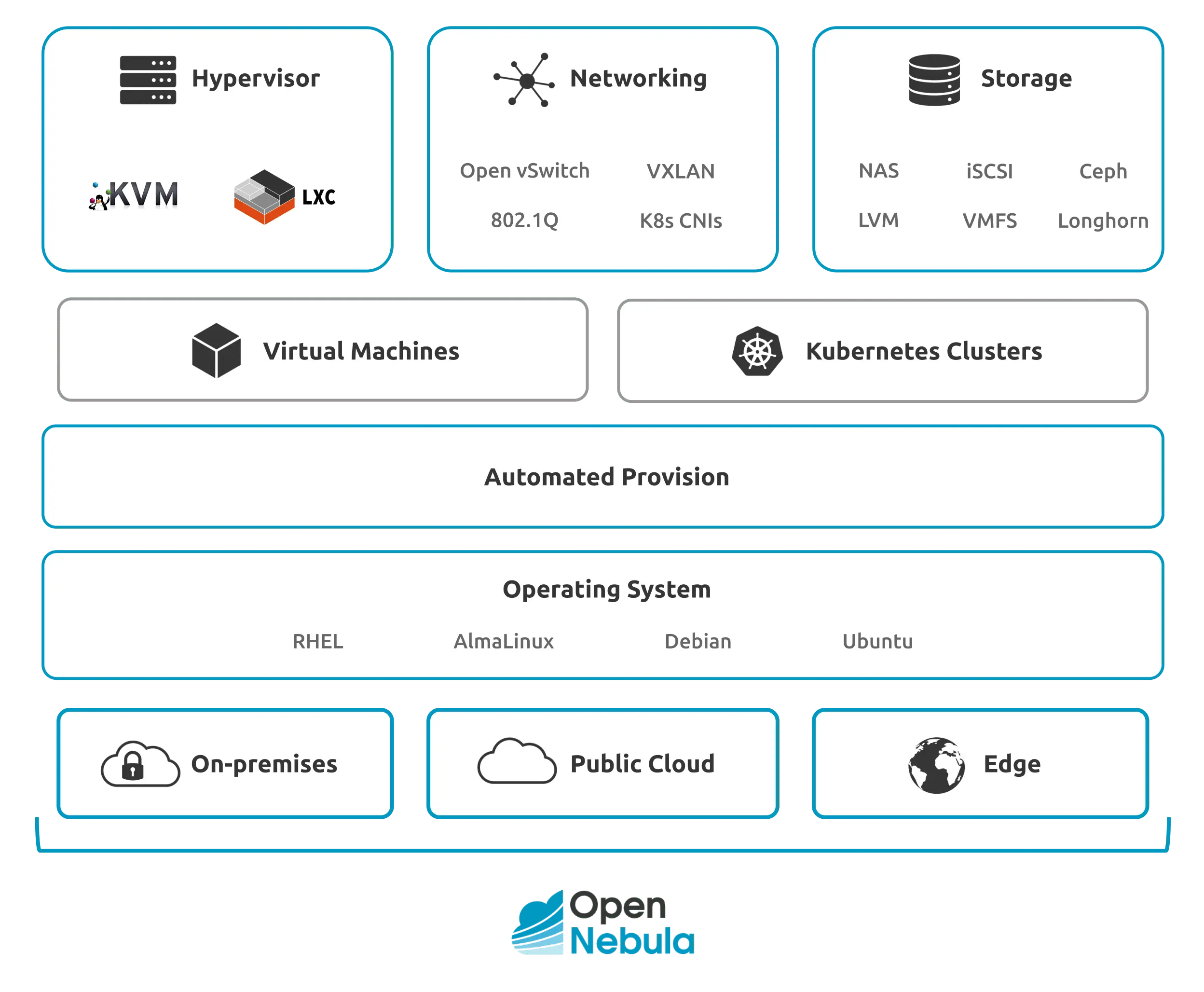
Unlike OpenStack’s distributed modular services approach, OpenNebula offers a more centralized architecture. This makes it lighter, easier to install, and generally simpler to operate – especially for smaller teams or organizations with limited cloud experience.

Out of the box, OpenNebula includes:

  • Support for multiple hypervisors like KVM, LXD, Firecracker, and VMware.
  • Integration with major public clouds like AWS and Azure for hybrid setups
  • Built-in container hosting using LXC/LXD or Firecracker microVMs

Like OpenStack, OpenNebula can manage applications by combining containerized workloads with Virtual Machine workloads in a common shared environment. Because of its lean design, OpenNebula shines in edge computing, lab environments, and non-demanding private cloud deployments. At a high level, OpenNebula trades some of OpenStack’s advanced capabilities for a quicker setup and lower operational overhead.

Key Differences at a Glance

Feature openstack logoOpenStack opennebula logoOpenNebula

Architecture

Modular, with independent components (Nova, Neutron, Cinder, Keystone, etc.)

Monolithic core with plug-in options

Complexity

High – flexible and customizable, but complex to deploy and manage

Medium – simpler architecture and easier deployment

Use Case Fit

Private and public clouds, telcos, enterprises

SMBs, edge deployments, simpler private clouds

Hypervisor Support

KVM, QEMU, Xen, VMware

KVM, LXD, Firecracker, VMware

Baremetal Management

With Ironic and built-in multi tenancy (BM managed along with VMs)

With OneProvision and templates. Requires addons.

Container Support

Kubernetes via Magnum, Docker via Zun or integrations with external platforms

LXC, Kubernetes through OneKE (SUSE Rancher)

Multi Region/AZ Support

Yes, with support on multiple levels and services incl. Keystone Federation

Yes, with Zones and Federation

Community & Ecosystem

Large global community, strong enterprise support (Red Hat, Canonical, etc.)

Smaller community, commercial backing by a single official organization (OpenNebula Systems)

Public Cloud Integration

Limited – mainly focused on private/hybrid clouds. Partial AWS API support (S3 and CloudFormation)

Hybrid clouds supported (with AWS, Azure integrations)

Storage Integration

Ceph and 30+ vendors supported (NetApp, Pure, Dell, HP, etc.) Support for Local, Block, Share and Object storage types. Own object storage solution (Swift).

Ceph, iSCSI/LVM, NFS.
A set of vendor storage solutions (NetApp, Pure, Storpool) supported.

Networking

Neutron – highly customizable advanced SDN (Firewall, Routers, VPNaaS, FIPs, VXLAN, GRE, VLAN, etc.) OVN/OVS and 3rd party SDN supported incl. Cisco ACI.

Simple networking with bridges, VXLAN and VLANs. Support for Open vSwitch (OVS).

Performance and Scalability

OpenStack is built for scale. It’s the engine behind massive private clouds like those run by CERN, Walmart, and Deutsche Telekom. If you need to manage hundreds and thousands of nodes with multi-tenancy, fine-grained RBAC, advanced networking, and complex automation – OpenStack excels.

OpenNebula, while more lightweight, is optimized for smaller or edge environments. It can still scale effectively, but its simpler architecture means it’s more suited for organizations that don’t need all the features of OpenStack or would like to keep things simple.

Ease of Use and Deployment

OpenNebula takes the crown here. Its all-in-one packages and not too steep learning curve make it easier to deploy and manage. It can be attractive to teams with limited DevOps resources.

OpenStack, while offering powerful tooling and a rich API ecosystem, typically requires a team with solid cloud and Linux expertise. At Cloudification, we help bridge this gap through managed deployments and 24/7 enterprise support which streamlines and hardens OpenStack for production.

Enterprise Readiness

Both platforms offer enterprise support, but to a different extent.

  • OpenStack is backed by a wide range of 3rd party vendors like Canonical, Red Hat, Mirantis and others. It also integrates tightly with modern tools like Kubernetes, Ceph, and Prometheus.

  • OpenNebula has a single commercial vendor – OpenNebula Systems – which can be seen as both a strength (focused development) and a limitation (vendor dependency and complete lock-in).

For regulated industries or critical production environments, OpenStack’s broader ecosystem and proven track record of large deployments make it a more common choice.

Licensing and Costs

Both platforms are open source:

  • OpenStack uses a highly permissive Apache 2.0 license with all features and services available for commercial and private use.

  • OpenNebula recently adopted a dual-license model – free for community use, but with some enterprise features gated under a commercial license.

From a long-term vendor lock-in perspective, OpenStack remains more transparent and community-governed. This aligns well with our philosophy @ Cloudification: open infrastructure, without lock-in or licenses.

Licensing and Costs

openstack logoChoose OpenStack if… opennebula logoChoose OpenNebula if…
  • You need scalability for enterprise or telco workloads
  • You want faster and simpler deployment
  • You’re looking for advanced networking, storage or multitenancy features
  • Your infrastructure needs are basic
  • You plan to integrate with Kubernetes, Ceph, and other open-source tools
  • You’re managing a single edge or small-scale cloud platform
  • You prioritize community governance and vendor independence
  • You’re looking for hybrid cloud integration with AWS or Azure

Our Take at Cloudification

In the post–VMware – Broadcom world, organizations can’t afford to get locked into rigid licensing schemes or proprietary ecosystems. Both OpenStack and OpenNebula offer open-source freedom – but they serve different needs.

We’ve worked extensively with OpenStack and built our c12n Private Cloud around it because it delivers scalability, openness, and long-term flexibility.

If you’re curious about other options, check out our OpenStack vs. Proxmox comparison for another perspective on open infrastructure choices.

Still unsure which one is right for you?
Get in touch with us – we’ll assess your requirements and help you migrate from VMware with confidence.

Blog > Cloud > OpenNebula vs OpenStack: Choosing the Right Open Source IaaS for Your Private Cloud
Let's Get Social: