
FREE MIGRATION GUIDE
VMware to OpenStack Migration Guide
A practical roadmap for moving from VMware to c12n.cloud
Free access · No registration required
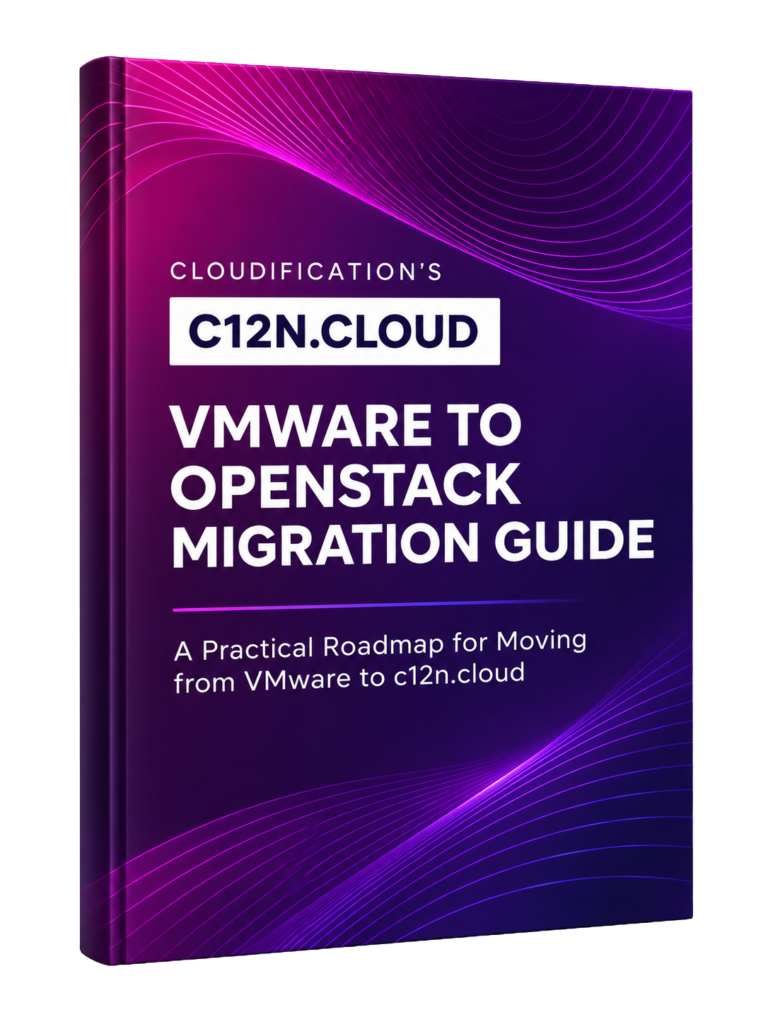
Table of Contents
Introduction: Your Migration Roadmap
As VMware moves to a subscription-only licensing model, many companies are considering how to migrate away from their current virtualisation environment. In this guide we walk through each stage of establishing a Private Cloud using OpenStack.
A number of factors will need to be considered when moving workloads to your new platform, including: application dependencies, storage, networking, availability requirements and supporting workflows.
Explore c12n.cloud as an open-source VMware alternative.
Written for: infrastructure teams, technical leads, and IT decision-makers evaluating a move from VMware to OpenStack.
Migration at a Glance

1.Infrastructure blueprint analysis

2. Dependency mapping
3. Target architecture
4. Environment preparation
5. Parallel deployment
6. Workload migration
7. Performance and failover testing

8. Post-migration support
01.VMware to OpenStack: What Changes?
These resources can be managed through:
Horizon Dashboard
Standardized APIs
Infrastructure as Code
How VMware capabilities map to OpenStack
| VMware capability | OpenStack / c12n option | Migration consideration |
|---|---|---|
|
ESXi and vCenter |
KVM; Nova, Horizon, Keystone |
Prepare guest OS drivers and adapt administration |
|
vSAN |
Ceph or a supported Cinder storage backend (30+ vendors) |
Reassess capacity, latency, storage policies, data movement, and QoS |
|
NSX networking |
Neutron and additional network/security components such as FWaaS or VPNaaS |
Map routes, segmentation, firewalls, and load balancing |
|
vMotion |
OpenStack live migration |
Moves VMs within OpenStack; VMware-to-OpenStack transfer uses non-OpenStack migration tools
|
|
VMware HA
|
Masakari
|
VM recovery service available as an optional deployment
|
|
VMware DRS |
Nova Scheduler / Placement; Watcher where deployed |
Validate required placement and optimization behavior |
|
VMware HCX |
Tools such as Coriolis |
Select a cross-platform transfer and cutover method |
Map outcomes, not just features.
Determine how your applications actually use each of these areas: automatic remediation, storage policies, network segmentation, integration with identity systems and observability. Define what you would expect to be true once this has been implemented, and verify this on your destination platform. Many processes will also need to be considered.
What you can reuse, and what needs conversion
May be retained
Existing x86 servers
Network switches
External storage
Guest operating systems
Selected IP ranges
ESXi hosts, which can be rebuilt for KVM once their workloads are migrated
Needs conversion or reconfiguration
VMware datastores
Ceph or a supported external storage backend
Virtual networking definitions
Neutron with OVN
c12n services
Core base services

Nova

Neutron

Cinder

Glance

Keystone

Horizon
Optional services, added when workload and operational requirements call for them:

Designate

Masakari

Manila

Octavia

Cyborg

Barbican

Ironic

Watcher
02. Assessing Your VMware Environment
List all current VMware infrastructure and compare allocated resources with typical and maximum levels of actual usage. This will allow an appropriate determination of the extent of the migration from VMware to OpenStack, related requirements, and criteria for successful completion.
What to capture
| Area | What to capture |
|---|---|
|
Virtual machines |
OS and version, vCPU/RAM usage, BIOS/UEFI, disks, controllers, snapshots, special devices |
|
Applications |
Business owner, upstream/downstream services, databases, authentication, scheduled jobs
|
|
Network
|
VLANs, IPs, DNS, gateways, MTU, firewalls, load balancers, external connections
|
|
Storage
|
Datastore types, used capacity, IOPS, latency, change rates, shared disks, backup dependencies
|
|
Continuity
|
Criticality, planned downtime window, RTO, RPO, restore method, acceptance tests
|
Key Migration Challenges
Dependencies
Identify these per application; for example, there may be several tiers (web, app and DB) that all need to be migrated together. Otherwise, identify any paths and services to be maintained between VMware and OpenStack environments.
Network identity
It may be possible to continue using the same IPs, and in some circumstances, the same MAC addresses. Alternatively, there may be a requirement to change IPs, and hence DNS, routing and other configuration such as load balancers. All existing NSX rules and security boundaries would need to be considered when creating new networks.
Storage
Usable capacity and achievable throughput will be of more relevance than raw disk totals. Write rates will be useful to determine approximate migration durations.
Guest compatibility
Desirable to know as early as possible, for example, older operating systems, disks shared between several VMs, directly attached hardware, software licenses dependent on various identifiers including MAC and IP.
Recovery targets and ownership
For critical workloads, define three values:
Planned outage
Permitted planned outage.
RTO
Recovery time objective
The target time for restoring service after a disruption.
RPO
Recovery point objective
The acceptable amount of data loss, measured in time.
Then assign clear ownership: the application owner approves functional tests, and the infrastructure owner verifies resource and connectivity requirements.
Assessment output
✓Prioritized VM inventory
✓Application dependency map
✓Capacity baseline
✓Compatibility exceptions
✓Proposed migration waves with named owners
These deliverables inform tool selection and target architecture design.
03. Choosing a Migration Strategy and Tools
To migrate from VMware ESXi to OpenStack, choose an appropriate migration technique, depending on acceptable downtime, rate of data change, and other considerations. It will generally be a mixture of techniques if it is a sizeable number of VMs.
Cold or warm migration?
| Method | How it works | Best suited to |
|---|---|---|
|
Cold migration
|
Stop the source VM, transfer/convert its disks, then start it in OpenStack |
Smaller workloads and applications with a generous maintenance window |
|
Warm / near-live migration |
Transfer data while the source runs, synchronize changes, then cut over within a reduced downtime window |
Larger workloads or tighter outage windows, where supported by the tool |
Watch out for
• Even warm migration will require a cutover period to complete sync, start applications, alter networking as required, and perform acceptance tests.
• If there is a fairly high volume of changes to the databases, this could require some co-ordination with the applications, or independent replication solutions.
• It may be preferable to recreate some legacy systems and other special configurations on to new VMs, migrating relevant data only.
Organize migration waves
01
Start with a representative pilot.
02
Migrate lower-risk production environments.
03
Move dependent and business-critical workloads.
Group applications by dependency and scheduled business windows. If ESXi hardware will be repurposed for OpenStack, record which hosts can be released after each wave.
Compare migration tools
| Tool | Main strength | Planning consideration |
|---|---|---|
|
virt-v2v |
Open-source guest and disk conversion to KVM |
Suited to planned offline transfers; check supported guest and VMware access modes |
|
MigrateKit |
Open-source VMware-to-OpenStack migration with pre-copy capabilities |
Validate source/target versions and operational requirements |
|
Coriolis |
Commercial migration and replication orchestration |
Evaluate connectors, network/storage mappings, support, and project cost
|
Test before production
Validate the selected tool against your VMware versions, guest systems, and OpenStack storage configuration. The pilot provides reliable figures for transfer throughput, final synchronization time, guest adaptation effort, and application validation. Use them to refine the migration windows for subsequent waves.
04. Preparing Your c12n Private Cloud
Set up all required components and test, ahead of migrating production workloads. Allow sufficient capacity to accommodate the initial waves of migration, and concurrent run of existing VMware infrastructure.
c12n.cloud is based on a combination of OpenStack and KVM, with Ceph or supported third-party storage, plus networking, automation and monitoring and other functions.
Cloudification’s recommended c12n production baseline
6
Physical servers
3 control-plane + 3 hypervisor nodes
1
Bootstrap host
Separate host, may
run as a VM
25+
Gbit/s
Data-plane network
1+
Gbit/s
Management network
Servers
Dedicated physical storage networks are strongly recommended, optionally with dedicated storage nodes.
Storage topology and usable capacity are sized separately for the selected Ceph or external storage design. Actual compute, storage, and network sizing follows from the assessment.
Reusing VMware hosts?
Prepare enough initial c12n capacity to migrate a first group of VMs before rebuilding the freed ESXi servers for KVM.
Storage and networking
Storage
Ceph provides distributed block and object storage. OpenStack can also integrate supported external arrays through Cinder and Manila drivers.
For either option, confirm the storage driver’s operations, expected latency, recovery behavior, and the conversion path from VMware disks.
For Ceph, account for replication or erasure-coding overhead when determining usable capacity.
Networking
Configure the target networks, subnets, routes, security policies, and required load-balancing connections.
Plan how applications will communicate across VMware and OpenStack during the phased migration, and document the IP or DNS changes required for each wave.
Operational readiness before the pilot
✓ Resource management
Teams can provision instances, attach volumes, access logs, and observe resource health.
✓ Monitoring, backup and recovery
Credentials, monitoring integration, and validated backup and recovery procedures are configured. c12n uses Prometheus, Grafana, OpenSearch, and GitOps automation; backup and disaster recovery may involve third-party solutions such as Storware or Trilio.
✓ Required OpenStack services
Required optional OpenStack services are identified, installed, and tested, including HA or load balancing where applicable.
Target-ready criterion
A representative VM can be deployed, connected, monitored, backed up, restored, and tested on the intended compute and storage hardware.
05. How to Migrate from VMware to OpenStack
There are 6 key tasks to be completed within the overall 8-phase migration journey to migrate a workload. All of these tasks have an aim, and a definition of done, allowing progression once complete.
Step 1. Prepare the source and target
Objective: Create an executable migration wave with known dependencies and a working recovery route.
- Freeze the wave inventory and map each source VM to target compute, storage, and network resources.
- Check VMware snapshots, disk layout, BIOS/UEFI, boot settings, and guest OS support. Plan VMDK conversion as required by the target storage backend.
- Prepare guest drivers and OS configurations: Windows commonly needs VirtIO storage/network drivers, Linux may require initramfs and bootloader checks. Review VMware Tools and virtual hardware-specific configuration. Migration tools can automate many guest OS preparation tasks, but some workloads may require manual adjustments.
- Confirm a valid recovery point, verify that the backup can be restored, and agree on application-level acceptance tests.
✓ Ready when: Every workload in the wave has an owner, migration method, recovery point, and target configuration.
Step 2. Configure the migration path
Objective: Establish reliable connectivity between VMware and OpenStack.
- Grant the required vCenter/ESXi and OpenStack API access with appropriate scope.
- Configure source and target endpoints, storage mappings, target networks, and any migration workers.
- Check transfer bandwidth, expected data volume, and the impact on production storage traffic.
✓ Ready when: A test transfer succeeds, and source/target permissions and mappings are documented.
Step 3. Run the pilot
Objective: Verify that the selected workflow can migrate representative applications.
- Migrate representative VMware VMs to OpenStack, covering both Windows and Linux where present.
- Test boot, attached disks, network adapters, application transactions, and dependencies.
- Record transfer speed, final synchronization duration, issues, and actual downtime.
✓ Ready when: Application owners approve the tests, and the wave schedule reflects the measured results.
Step 4. Stage workloads for migration
Objective: Prepare target resources and stage workload data where supported by the migration method.
- Cold migration: prepare target compute, storage, network resources, and mappings without shutting down the source VM.
- Warm migration: perform an initial copy while VMware remains active, then synchronize subsequent changes. This is normally handled by migration tooling but requires testing for specific guest OS versions.
- Prepare the procedures for the final consistent transfer and, for transactional systems, any application-specific data reconciliation during cutover.
✓ Ready when: Target resources and mappings are ready, and any warm migration pre-copy is sufficiently synchronized for the agreed production window.
Step 5. Cut over to OpenStack
Objective: Switch the production service within its approved maintenance window.
- Hold a Go/No-Go decision with the application and infrastructure owners, and verify the recovery point.
- Stop or restrict application writes on the source as required by the approved consistency procedure.
- Cold migration: shut down the source VM and transfer or convert its disks. Warm migration: complete the final synchronization after source writes have stopped, ensuring the source cannot resume conflicting production writes.
- Verify the final dataset using the migration tool and any required application-specific reconciliation procedures, then start the target workload.
- Apply DNS, routing, IP, or load-balancer changes and run the agreed functional tests.
- Record acceptance or execute the approved recovery procedure before the decision deadline.
✓ Ready when: The application owner accepts the migrated service, and the operations team can monitor its health.
Critical rollback rule
Once the target has accepted new production writes, the original VMware VM may no longer contain recent transactions. The recovery plan must identify the authoritative dataset and specify how to preserve or restore those changes. Throughout cutover and recovery, prevent concurrent conflicting writes. Migration tools can automate parts of the rollback process, but recovery after production writes begin on the target requires a validated, workload-specific procedure.
Step 6. Validate, stabilize, and hand over
Objective: Establish the migrated workload as an operable production service.
- Compare application response time, storage latency, and network behavior with the baseline.
- Verify backup restoration and relevant failure-recovery scenarios.
- Update inventory, monitoring, credentials, runbooks, and support ownership.
- Retain the source environment for the agreed stabilization period, keeping migrated source VMs powered off or isolated from production to prevent conflicting writes. Decommission the source environment only after dependencies are cleared.
✓ Ready when: The migration wave meets its acceptance criteria, and the next wave can proceed using the refined plan.
06. VMware Migration Economics
Example environment: VMware Cloud Foundation (VCF), 15 servers with two 24-core processors each, for a total of 720 licensed cores.
- VMware: 350percoreperyear,or**252,000 per year**, including standard subscription support
- c12n one-time costs: $40,000 deployment + $16,000 migration + 7,000training=**63,000**
- c12n technical support: $54,000 per year
- Both scenarios reuse existing compatible hardware.
| Period | VMware VCF | c12n.cloud | Estimated savings |
|---|---|---|---|
|
1 year
|
$252,000 |
$117,000
|
54% |
|
3 year
|
$756,000
|
$225,000
|
70%
|
|
5 year
|
$1,260,000
|
$333,000
|
74%
|
Pricing note: This is an illustrative platform-cost scenario based on a publicly reported 2026 VCF pricing benchmark, not a customer quote. Actual rates and savings depend on the VMware product and contract, c12n project scope, staffing, and third-party services, so these items should be added to an organization-specific TCO model. Source: AceMQ, VVF vs. VCF: Price per Core (updated October 2026).
07. Migrating with Cloudification
Cloudification can advise on various aspects of an OpenStack architecture, implement a private cloud, migrate workloads to this and provide continued support. They would establish which clusters and associated workloads would be affected, what connectivity must remain available during the transition and what functionality to provide from the destination platform.
Case study: Private cloud for a FinTech company

FinTech company
Migration from VMware to an OpenStack- and Kubernetes-based private cloud supporting both Linux and Windows workloads.
VMware Replacement
Who owns what
May be retained
Target capacity
Networking
Platform access
Application owners
Business transactions
Data consistency
Functional acceptance
Prior to production activities, the migration plan will specify who is responsible for migrating various components, making the decision to cut-over, and the recovery process.
All c12n configuration would be managed using GitOps on the customer’s infrastructure following completion and handover. The customer may choose to run this themselves, or use Cloudification to support and possibly run the private cloud on their behalf. Monitoring, response to incidents, patching and upgrading, responsibility for backups, and escalation paths are all issues to be agreed during the project.
Sources and Further Reading
- Cloudification, VMware Alternative: https://cloudification.io/vmware-alternative/
- Cloudification, c12n Private Cloud (architecture and FAQ): https://cloudification.io/c12n-private-cloud/
- Cloudification, FinTech migration case: https://cloudification.io/case-studies/case-private-cloud-migration-from-vmware-to-openstack/
- Cloudification, Migration Tools: https://cloudification.io/cloud-blog/migrating-from-vmware-to-openstack-top-tools-to-streamline-your-transition/
- OpenInfra Foundation, VMware to OpenStack Migration Guide: https://www.openstack.org/vmware-migration-to-openstack/vmware-to-openstack-migration-guide
Get the Full Guide
The downloadable guide also includes two ready-to-use checklists:
VMware Migration Readiness Checklist
For the assessment stage and approval of the first production wave.
Cutover, Acceptance & Rollback Checklist
For the Go/No-Go meeting and the migration window.
Free access · No registration required
Planning Your VMware Migration?
The downloadable guide also includes two ready-to-use checklists: